
The author is a postgraduate in Islamic Studies from University of Birmingham, UK.
When discussions around Islam and China arise, the focus almost inevitably turns to the Uyghurs, ethnic minorities, and state-led assimilation policies. Rarely does the conversation extend to the more complex reality of Islam’s historical and ongoing presence within China. Even fewer consider that the country could be home to scholars and experts in Islamic Studies. If we pay closer attention to this overlooked dimension, we will find that Islam in China has a deep-rooted history and in the modern world, Ma Jian, an Islamic Studies and Arabic expert who played a crucial role in propagating the subject in the country.

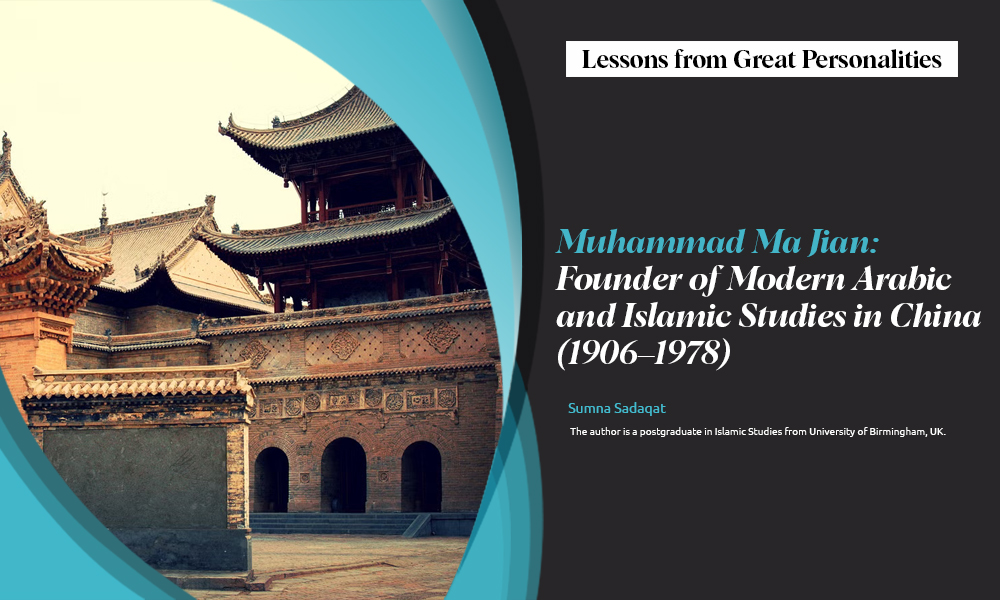
Islam’s roots in China stretch back over a millennium, reflecting a profound historical presence. It goes as long back as the time of the earliest companions of Prophet Muhammad PBUH. The first Islamic missionary to China was Sad ibn Abi Waqas, who brought the message of Islam to the rulers of the Tang dynasty. Xian was one of the first cities in China to encounter Islam, brought by Arab and Persian merchants, diplomats, and soldiers who arrived via trade and maritime routes. In 742 CE the Great Mosque of Xi’an, one of the oldest and most architecturally unique mosques in China was built. It reflects traditional Chinese architectural styles—a symbol of Islam’s integration into Chinese culture. Muslims whose practices were in harmony with Confucian and local Chinese customs were referred to as Hui Muslims. Under the Yuan dynasty Muslim population continued to grow after the migration of Central Asian Muslims who were escaping the Mongols. During this time, cities such as Yunnan became the epicentre of Muslim rebellion (Panthay Rebellion 1856-73) against the Qing dynasty involved in religious and ethnic persecution. Although the rebellion was crushed, it cemented Islam’s resilient identity in the region.
Under the communist party of China, Muslims were brought under the authority of the “patriotic” Islamic Association of China (IAC), which was established in 1953. Currently, there are approximately 17–25 million Muslims in China, less than 2 percent of the total population. This number is greater than the population of many middle eastern countries like Jordan, Bahrain and others. Thus, Muslims and Islam in China needs attention. Hui Muslims are the most numerous groups, most Muslims reside in northwestern China’s Xinjiang autonomous region, which contains a significant Uyghur population. This region has remained in headlines for years because of Chinese government’s rigorous efforts to strip the locals of their religious identity.
Islamic scholars and preachers have played a significant role in spreading the religion across the world. And China is no exception. It has produced great Islamic thinkers such as who shouldered the responsibility of catering to the needs of the locals. One such learned man was Ma Jian. He was born in 1906 in a place called Shadian, in the province of Yunnan. He completed his schooling in 1925 and began teaching at a local primary school. His quest for learning eventually led him to learn from the great Chinese Imam, Hu Songshan/ Sad al-din, who abandoned Wahabism to become a staunch advocate of Chinese-Muslim unity in the country. In 1929 Ma Jian decided to take admission into the private Shanghai Islamic School to improve his religious knowledge. In 1931 the school sponsored him for a scholastic trip to Egypt in order to perfect the Arabic language and receive professional Islamic training. The school wanted him to master the sciences so well that he could translate the Quran into Chinese vernacular language. And after seven years, when he came back to China in 1939, he had mastered both language and religion to such an extent that he undertook the tremendous task of translating the Quranic text into Chinese. He also translated Chinese cultural, historical and mythological works into Arabic such as Analects (Lun Yu), The Tea God (Cha Shen), The Story of Hebo’s Marriage (He Bo Qu Qi), and Chinese Idioms and Axioms (Zhongguo Geyan Yanyu). Along with that he continued to teach students at Yunnan University. He became one of the firsts Arabic language professors at Beijing University in 1946. Later he became a member of the Chinese Islamic Association. He also served as a consultant to the government on internal and external matters related to Muslims and Islam in general. He translated the Chinese constitution into Arabic and the Egyptian constitution into Chinese in the 1950s. He continued to work on Quran’s translation even when he fell into political disfavour later on until his death in 1978. His translation of the Quran was officially accepted by the Religious Department of Saudi Arabia in 1987 as the standard Chinese translation. He went on to translate other works into Chinese such as Risalat ul Tawheed of Muhammad Abduh, PK Hitti’s History of the Arabs, Husayn al-Jisr’s The Truth of Islam, Khalil Abdullah Totah’s Contribution of the Arabs to Education amongst others.
He strongly argued for a Muslim- Non- Muslim unity in China and promoted the religion through his writings as well. He encouraged Islamic Madrasas to impart Chinese education to its students so that they are capable of promoting Islam appropriately to the masses. He also advocated for modern education, calling out parents to make their children doctors, teachers and learned professionals and not just religious preachers. But simultaneously he critiqued the government for not imparting religious knowledge to Muslim students, distancing them from modern structured schools. He wanted basic Islamic courses to be taught to Muslim children so that they could practice their religion easily. Thus, he had a very balanced approach towards education. He wanted Muslim children to learn new things while paying full attention to Islamic principles. Concurrently he demanded the Chinese government to include religious education in state schools for Muslims just like there was a provision for non-Han minorities. But both the Republican and Communist parties rejected his proposals, in the name of assimilating minorities within the Chinese society. Seeing the reluctant response of the Chinese government he suggested to run scholarship based Muslim institutions to impart both religious and Chinese education. He helped in establishing Arabic and Islamic Studies departments in universities such as the Peking university. Along with that, he encouraged students to learn more and taught the modern generation of scholars such as Zhu Weilie and Lin Song.
Ma Jian was successful in bridging the gap between Muslims and the Chinese state. Most importantly, he played a pioneering role in making Islam accessible to both Muslims and Non-Muslims through his valuable translation works. His efforts become more significant under the circumstances of a majoritarian regime in a Muslim minority context.

0 Comments