
The author is a published writer and a passionate legal student with a flair for writing that inspires and empowers
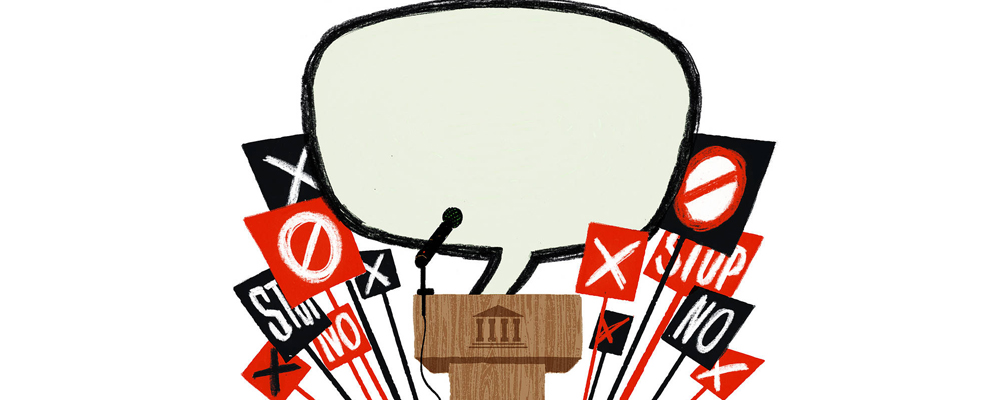
“To speak one’s truth is a right. To silence that truth is tyranny.”
India, the land that once echoed with the revolutionary poetry of Faiz, the fiery words of Bhagat Singh, and the rational thought of Ambedkar, is witnessing a slow, calculated erasure of its soul today. The soul that breathes in the freedom to ask, to dissent, to challenge, to joke, to write, to sing, to mourn, and to imagine. That soul is under fire.
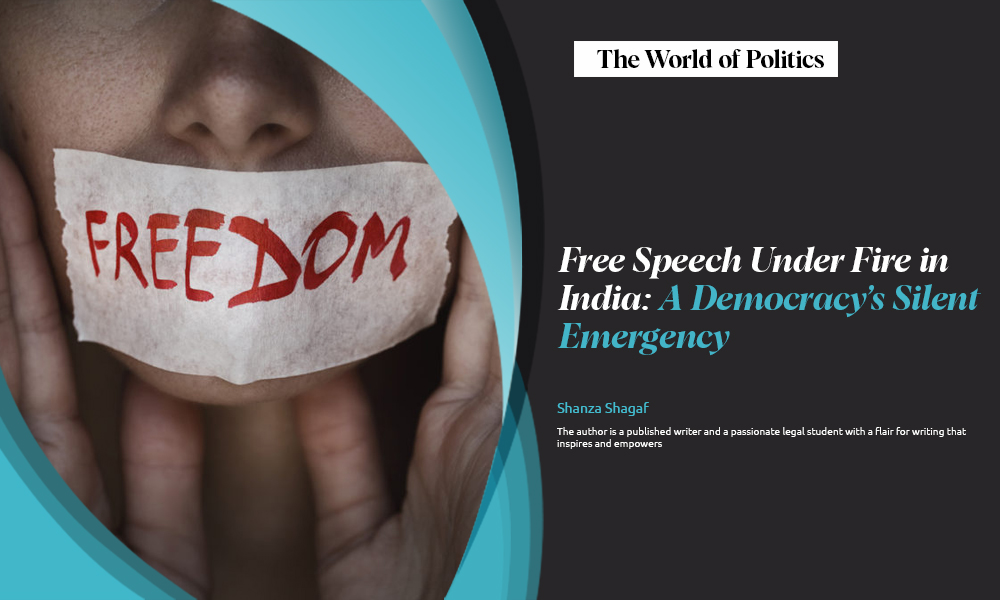
Freedom of speech is not just another constitutional right—it is the bedrock of any democracy. Yet, what we see around us today is a chilling crackdown on dissent, a systematic delegitimisation of critique, and a deepening culture of fear, where even the act of asking questions is being branded as sedition.
From Shaheen Bagh to Silent Screens: The Many Faces of Suppression
The story doesn’t begin with a single arrest or a particular book ban. It is far more insidious—a tapestry of silences, broken pens, cancelled shows, shutdown newspapers, and jailed thinkers.
When students raised their voices against discriminatory laws, they were met not with dialogue but with tear gas and police batons. When journalists exposed state failures, they were hounded with FIRs, sedition charges, or worse, mysterious deaths. When comedians joked about power, they were jailed pre-emptively, not even for a joke told, but for one that might have been told.
And when citizens tried to mourn the death of democracy through art, poems, or peaceful protests, they were labelled as “urban Naxals”, “anti-nationals”, or “terror sympathisers.”
This is no longer an issue of isolated incidents. It is a pattern in an ecosystem built to ensure compliance, crush critique, and delegitimize all forms of alternate thought.
Book Bans, Legal Intimidation, and a Fragile National Ego
Books, the very symbol of knowledge and plurality, have become prime targets. Scholarly works that question dominant narratives are labelled as “distorting history.” Fictional tales are accused of “hurting sentiments.” Critical academic research is dubbed “foreign propaganda.” A hypersensitive nationalism now dictates what may be read, and who may read it.
Authors like Arundhati Roy, Perumal Murugan, and countless others have faced legal harassment or threats of violence. School syllabi are being purged of “liberal” thinkers. Libraries in universities are being shrivelled. The result is a climate of self-censorship, where writers hesitate before putting pen to paper, fearing that any word can be weaponised.
The War on Journalism: Truth as a Threat
India’s place on the World Press Freedom Index has been slipping steadily, and for good reason. Investigative journalism has been replaced with “X Media “, a term that symbolises news channels that have bent their knees before power, glorifying the government while vilifying anyone who questions it.
Independent journalists are surveilled, raided, or arrested. The Pegasus spyware scandal showed how journalists’ phones were hacked—not by criminals, but allegedly by the state itself. Media houses critical of the regime face constant income tax raids, withdrawal of government ads, and online smear campaigns.
Even in the digital space, platforms are pressured to remove content or reveal user identities. The government’s IT rules 2021 placed arbitrary controls on digital news portals and OTT platforms, demanding content removal without transparent procedures.
What remains is a media that speaks no truth to power, but power to truth.
Who Decides What’s Offensive? The Tyranny of Sentiments
A question haunts us in this climate: Who gets to decide what is “offensive”?
Is it a political party? A religious group? A WhatsApp mob? The court of public outrage?
Today, offence is not about actual harm—it is about dominance. Majoritarian sentiments have been given a veto over reason, art, humour, and scholarship. If a film explores caste, it offends “tradition.” If a book discusses communal riots, it offends “national unity.” If a tweet critiques a policy, it offends “soldiers.” If a poem mourns the loss of justice, it offends “development.”
We now live in an era where offence is weaponised, not felt. The state uses it to jail, to silence, and to control. This is not the work of a healthy democracy—it is the method of an insecure regime.
The Shrinking Space for Satire and Art
India has a rich tradition of satire from Birbal’s wisdom to R.K. Laxman’s Common Man. But in the current climate, satire has become dangerous. Comedians like Munawar Faruqui and Agrima Joshua face mobs and police for jokes, some not even made.
Art must comfort the disturbed and disturb the comfortable. But now, only the “comfortable” have protection. Plays are cancelled, exhibits are attacked, and films face boycotts, bans, or censorship. Creative expression is being punished, not protected.
This is the death of imagination, and with it, the slow decay of culture.
The Danger of Normalising Fear
The biggest tragedy is not just the repression itself, but its normalisation. When students are jailed, we move on. When journalists are raided, and we scroll past. When books are banned, we say, “Well, maybe it was controversial.” When comedians are assaulted, we think, “They should have known better.”
This apathy is what authoritarians thrive on. Silence is their fuel. Indifference is their shield.
But we must remember: What is being done to a few today can be done to many tomorrows. You may not be a journalist, an artist, or an activist, but the day your words, beliefs, or conscience come under attack, you’ll wish someone had spoken up when it began.
The Way Forward: A Nation That Listens
India must return to its constitutional promise, a nation that does not fear its people but draws its strength from them. Free speech is not a Western luxury. It is an Indian legacy.
We need legal reforms that protect free speech, not restrict it. We need independent institutions that don’t bend to the will of power. We need a civil society that resists not just in courtrooms but speaks loudly in classrooms, homes, streets, and on screens.
Most importantly, we need courage—the courage to listen, the courage to laugh, the courage to disagree, and the courage to stand up when others are silenced.
In Conclusion, India’s Voice Must Not Fade
India was never meant to be a nation of silent citizens. We are a country of tea stall debates, passionate protest poetry, fiery parliamentary speeches, and raucous college unions. We must protect that spirit not just in law but in life.
Because when the right to speak freely dies, democracy dies with it, not with a bang but with a whisper no one is allowed to hear.
Let us not be the generation that watched silence spread like smoke across a burning constitution—and did nothing to stop it.
0 Comments