
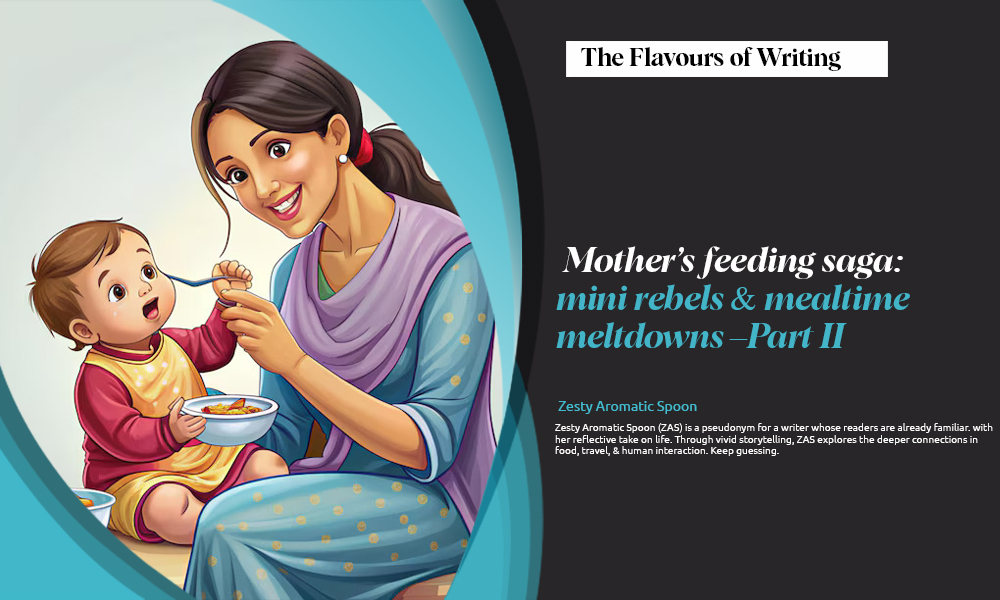
Zesty Aromatic Spoon (ZAS) is a pseudonym for a writer whose readers are already familiar. with her reflective take on life. Through vivid storytelling, ZAS explores the deeper connections in food, travel, & human interaction. Keep guessing.
Dear Aura Readers,
I hope you enjoyed the previous chapter on the great Indian food culture surrounding pregnancy. Now, brace yourselves for the sequel, a nostalgic dive into the next phase of this deliciously chaotic journey- the feeding adventures that follow the baby’s grand arrival.
After surviving months of advice, instructions and an endless list of dos and don’ts, the baby finally arrives. But little do we realise that the real food drama is just beginning. The debates, confusions and culinary experiments around what goes into the tiny stomach of this new arrival become the next full-time project.
Of course, the rulebook requires exclusive breastfeeding for six months, a commandment most mothers try to follow religiously. But once the clock strikes the six-month milestone, mothers find themselves at a crossroads of confusion.
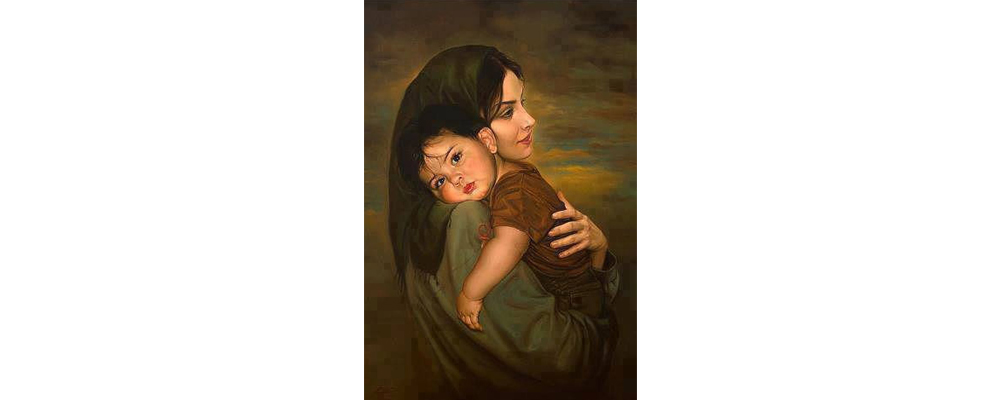
In the pre-Google era, before the age of “instant information” and online mom forums, new mothers would simply stick to the tried-and-tested menus passed down by the wise elders at home. When I became a first-time mother, I too followed this tradition. I would meticulously wash and roast rice and various lentils, grind them into a fine powder and cook them into a smooth porridge with a touch of salted butter or ghee for my seven-month-old baby. Giving sugar to babies was a big No, No!!
Later, Ragi porridge made its grand entry into the menu, a recipe kindly taught to me by a neighbour, since I lived away from the comforting chaos and constant supervision of the extended caring joint family. In her tone of seasoned expertise, the neighbour instructed me carefully, “Cook the ragi porridge until it leaves the sides.”
And so began my next culinary mission. I stood before the pot, eyes fixed, spatula in hand, stirring continuously as though performing a scientific experiment. My sole purpose was to ensure that not even a tiny bit dared cling to the sides of the pan. Every bubble mattered, every stir was watched with full concentration. I felt as if the entire success of my baby’s nutrition depended on this sacred moment of detachment between porridge and pot.
Now that my baby’s solid food journey had begun, a feeling of mini accomplishment was inevitable with every meal.
With the first menu finally in place, there was no looking back.
And yes, some of today’s young mothers might wonder, “Where’s the boiled and mashed apple? The pureed bananas?” Well, back then, fruits were kept at a safe distance. Strictly on the no-entry list, thanks to the collective wisdom of elderly voices warning that fruits might invite colds, chest congestion or mysterious seasonal illnesses. So, we obediently stayed loyal to our humble porridges.
Then came another gem of advice I regret following: someone confidently declared that babies shouldn’t be given water until they turn one. And like many anxious first-time mothers, I followed it. My poor firstborn went without water until he was 11 months old, and when he developed measles due to the body heat, the blame naturally circled back to me-“You didn’t give him water, that’s why!”
Even now, I wish I could go back and politely tell that well-meaning adviser how much I regretted listening to her. But isn’t that the universal story of motherhood? We all carry a small collection of regrets, especially with our firstborns, who unwittingly become the subjects of our trial-and-error parenting experiments.
Gradually, we were guided to introduce boiled eggs, small portions of meat and finally the much-awaited fruits, all carefully scheduled and cautiously served. Every new addition came with elaborate instructions, especially foods that could help soothe the baby’s teething cravings. But like clockwork, the baby’s tiny stomach would promptly stage a protest each time a new food item made its debut. And naturally, every upset tummy or rash returned to the mother’s “carelessness.”
And then comes the legendary teething phase, when the baby enters full-blown exploration mode, determined to put everything into their curious little mouth. During this phase, mothers, too, experience their version of athletic training, sprinting behind their mini adventurer, confiscating anything and everything that might even remotely fit between those tiny gums. My elder daughter, however, took her teething adventures to a whole new level. She discovered a secret little corner of the wall, her private excavation site, where she could quietly dig out bits of sand with her tiny fingers and lick them like a gourmet treat. Those little fingers had practically turned into miniature earth movers, diligently scraping away at the wall, much to my horror and her great satisfaction.
When those tiny pearl-like teeth start appearing, every breastfeeding mother silently prepares for battle, because behind that innocent gummy smile now lurks a little biter. And each time the baby tests their new dental equipment mid-feed, a part of the mother’s soul momentarily leaves her body. This, without exaggeration, is every nursing mother’s shared nightmare, one sharp chomp at a time.
These painful little moments remind us of the unmatched status of a mother. She is elevated in honour for every sleepless night, every tear, and every sacrifice. As the Prophet Muhammad said, “Your mother, your mother, your mother, and then your father.” This is a reminder that even these tiny tests are counted in her reward scale.
But once the teeth arrive, suddenly, everyone in the family turns into a self-appointed nutritionist, slipping morsels into the baby’s mouth at every possible chance. Meanwhile, the mother stands there, staring helplessly, trying to decode the eternal mystery: Is my child full? Hungry? Overfed? Underfed? Should I still offer something or surrender to fate?
When the child stubbornly refuses to eat, maternal panic kicks in at full throttle. Many a mother has found herself frantically negotiating, coaxing, and, let’s be honest, occasionally raising her voice at the tiny rebel. The baby’s loyal army of Avengers assembles when she reaches her breaking point. The grandparents, aunties, uncles, neighbours, and even guests (at times) rush in to rescue the little one from the supposed “tyranny” of food.
Feeding a toddler is not less than climbing Mount Everest with a blindfold in a storm while singing nursery rhymes. Nothing seems to work in the stories, the songs, the bribes, the warnings, the praises, the promises, and the dramatic sighs. And when, after all these grand efforts, the child still refuses to eat, the final reward for the mother is the guilt, seasoned generously with self-doubt.
Yet, in these chaotic, exhausting moments, a mother’s heart finds calm in the thought that tests of sabr and shukr lie in these struggles. After all, isn’t it He who says in the Qur’an: “And it is He who feeds and gives drink” (Surah Ash-Shu’ara, 26:79)? The rizq (provision) of this little one was always written, and sometimes, that includes the half-chewed roti and the mysterious wall-sand delicacies too.
In today’s modern parenting toolbox, one magical shortcut seems to have solved the age-old feeding battle: the mobile phone. Hand over the screen, play a few animated songs or dancing vegetables, and voila! The child slips into a hypnotic trance, mouth automatically opening on cue like a tiny robot. What we see is mindless, mechanical eating while the mother sits back triumphantly, as if she has completed an Olympic event. No signs of tantrums, negotiations and no ‘one bite for Mummy, one for Daddy’ dramas.
If we walk into any family or social gathering, we are sure to spot rows of children glued to glowing screens while mothers expertly sneak spoon after spoon into their distracted little mouths. In parks, restaurants, and airports, every child seems permanently attached to a screen, eyes fixed, fingers tapping, food quietly disappearing like magic.
While the task may be getting done easily, are we raising children whose bodies are nourished but whose hearts and minds remain hungry? We as mothers need to remember that the amanah of raising a child is not just about feeding the stomach. It’s exclusively about nurturing the soul. And though these tiny humans may not remember how much khichdi we fed them, they will carry the presence, warmth, values and attention we offered, or failed to provide, during these small, sacred moments.
As mothers, we transfer far more than milk or spoonfuls of mashed mystery vegetables. Along with every bite and burp, we’re sneakily passing on our quirks, wisdom (and sometimes anxieties), values and dramatic storytelling skills into these tiny humans. That’s why, even amidst the flying spoons, spilt porridge and impromptu wrestling matches at mealtime, it’s worth remembering that we’re not just filling their tummies, we’re quietly shaping the future… one sticky, chaotic, slightly overfed moment at a time.
Assalamualaikum
Such a beautiful, heartwarming piece — mashallah. Once again, I found myself wandering through those cherished lanes of memory, when I used to feed my children with my own hands. I never really knew how full their little bellies were, but by feeding them, I felt my own heart and soul completely nourished.
Today, my children have grown up, yet there are still always a few bites in my plate meant just for them. Even now, they come to me, open their mouths, and say, “One bite for me, one bite for me… Ammy, food from your hands still tastes just as magical as it did in our childhood, when you would feed us while showing us the moon and stars.”
Truly, this is not merely food — it is a thread of love, a lifetime bond woven with every morsel, every memory.
Great writing once again. Allahumma barik. Very vivid, it was like watching a movie with so many nostalgic moments. Your story telling skill is amazing. Hoping to read mire from you.