
The author is a student and homemaker
A few weeks ago, several events sparked conversations in my neighbourhood. A middle-aged widow and mother of three remarried a man of her choice—an act that caused distress not only among her relatives and friends but also her own children. People began saying all sorts of things about her. She was boycotted from social gatherings and even removed from various WhatsApp groups.
Another incident soon became the centre of discussion. A young woman, living with her two grown-up sons and her ailing mother-in-law, decided to move back to Dubai to rejoin her husband, who had long been working and residing there. Her sons, too, were about to leave for different cities to pursue their careers. The question arose—what about the mother-in-law, who was almost bedridden, half-paralysed, and entirely alone?
The woman asked her in-laws to take care of her mother-in-law, but they bluntly refused. Even her two sisters-in-law, who lived in the same city, declined to take any responsibility for their mother. Left with no other option, the woman arranged for a caretaker and left with her husband. However, her decision attracted immense criticism. A religiously inclined figure in the community, she was soon labelled a selfish daughter-in-law, accused of failing to live by the very values she preached.
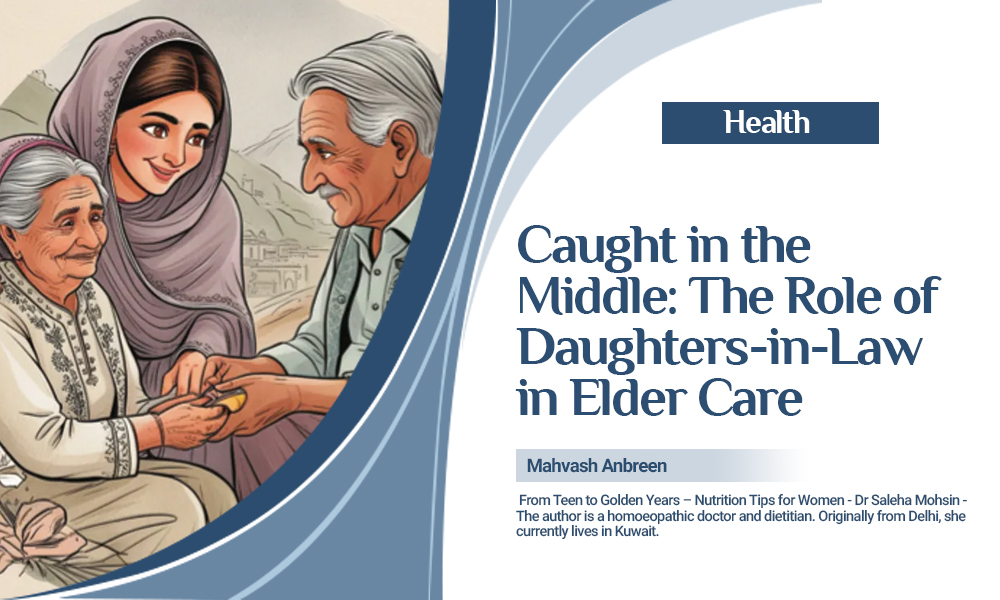
In countries like India and Pakistan, caring for ageing parents is often seen as the sole responsibility of the daughter-in-law. Once married, women are expected to move into their husband’s household and care for all members, managing household chores and elder care as if it is their primary duty.
This cultural practice has been followed for centuries with little resistance. From a young age, women are conditioned to believe that caring for elders is an essential part of their marital duty. They are expected to do so silently, without complaints or recognition. These expectations are reinforced by media portrayals, family elders, and broader community norms.
The Invisible Load of Caregiving
However, elder care is no simple task. It places a tremendous physical and emotional burden on the caregiver. From feeding, administering medicines, and helping with mobility to managing chronic illnesses, the workload can be overwhelming. On top of this, daughters-in-law are often still responsible for looking after children and running the household. Most of this labour goes unrecognised and unsupported. Even practical steps, such as hiring help or employing a caregiver, are often frowned upon.
Many daughters-in-law report feeling unappreciated, emotionally drained, and overworked. The constant expectation to remain patient, kind, and endlessly available often leads to emotional suppression and eventual burnout—especially when relationships with in-laws or spouses are strained.
Unpaid Labour and Lost Identity
The work performed by daughters-in-law is unpaid, and it often forces women to give up their careers and aspirations. Dreams are deferred, hobbies disappear, and social connections wither. Over time, many women experience isolation and a loss of self-worth. Financially, wives remain dependent on male family members. While this division of labour may once have been rooted in love, over time it has evolved into an unfair and outdated obligation.
To build healthy families, caregiving responsibilities must be shared. In the earlier example, the old mother-in-law was being cared for by just one person, despite other capable family members being present. While acts of love and care are admirable, they should not come at the cost of a single individual’s well-being. Siblings—regardless of gender—must share responsibility. Husbands, too, must play an active role in elder care, rather than limiting themselves to being financial providers or silent observers.
Professional caregiving services or domestic help should be embraced when needed, not stigmatised. Care isn’t just a moral duty; it is an act that requires infrastructure, support, and resources.
A Call for Change
Governments and NGOs must collaborate to establish support programmes, offer caregiver benefits, promote mental health awareness, and raise public understanding of the challenges faced by unpaid caregivers. Legal recognition of unpaid domestic and elder care work is also vital to prevent the financial marginalisation of women.
Families must move away from gendered traditions and towards shared responsibility. The well-being of the caregiver is just as important as that of the elderly person receiving care. Love should be encouraged, not enforced by cultural norms. Responsibility should be distributed based on capacity, willingness, and available resources—not marital status or gender.
Mutual respect, open communication, and shared effort must be the foundation of every family. After all, every person must eventually experience ageing. Preparing for it collectively—with empathy and equity—is the only way to build families and societies that honour both our elders and those who care for them.

A topic that needs to be addressed in the society. Everyone enquires about the aged parent, their well being, comes with loads of suggestions or sometimes criticisms.An empathetic word to the caregiver would make her day.Try to not have food from the houses were there is an aged or ailing parent and there is no one to help the caregiver. We can carry home cooked meal if possible and give them
An excellent and sensitive portrayal of the situation and very valuable solutions. It really touched me, as it will touch all of us. My congratulations the writer for her frank and bold attempt to deal with such a complex yet so relevant issue.