
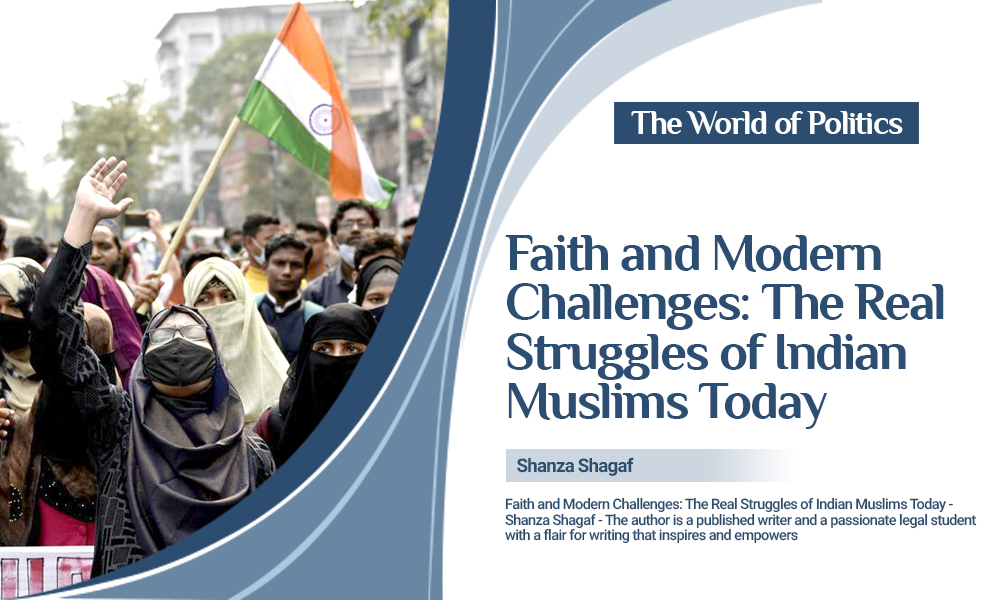
The author is a published writer and a passionate legal student with a flair for writing that inspires and empowers
India’s Muslim community, over 200 million strong, is the country’s largest minority group and among the largest Muslim populations globally. Yet, for many Indian Muslims, faith is intimately woven not only into spiritual practice but into their very struggle for justice, belonging, and dignity in the face of mounting modern challenges.
BOX TEXT
Economic and Educational Marginalisation
Despite constitutional guarantees of equality, Indian Muslims face a legacy of structural disadvantage. Data from the Sachar Committee Report (2006), a government-commissioned inquiry, revealed that Muslims are underrepresented in government jobs, overrepresented in informal labour, and lag behind most other communities in education, income, and access to public services. The report identified Indian Muslims as more socio-economically backwards than even the scheduled castes and tribes.
This economic marginalisation is worsened by limited access to quality education. According to an analysis by the Centre for Policy Research, Muslim children have lower enrollment rates in higher education, and institutional discrimination often limits access to opportunity even for those with merit. Many of the poorest Muslims are excluded from affirmative action benefits because they fall outside India’s official backwards caste categories.
Social Exclusion and Fear
Religious identity has become a marker of vulnerability in India today. According to a report by the Council on Foreign Relations (2023), the rise of Hindu nationalism under the BJP-led government since 2014 has been accompanied by increased hate speech, mob lynchings in the name of “cow protection,” and targeted online abuse, such as the “Sulli Deals” and “Bulli Bai” apps that auctioned images of Muslim women.
A 2022 Pew Research study on religion in India found that while most Indians support the idea of religious tolerance, they also prefer keeping a distance from people of other faiths. Social segregation remains high, and Muslims routinely face housing discrimination, hostility in public spaces, and overt surveillance.
Moreover, according to a 2023 report by BYU’s Ballard Centre, nearly 79% of Indian Muslims said they feared future violence or state action against them. This constant state of anxiety affects how freely they participate in society and undermines their sense of belonging.
Political Marginalization
Muslim political representation has steadily declined over the past decade. Following the 2019 general elections, Muslims made up just 5% of the Indian Parliament — far below their 14% share in the population. Notably, the ruling Bharatiya Janata Party (BJP), which promotes a Hindu nationalist agenda, has frequently had no Muslim MP in its ranks — a symbolic erasure that weakens policy-level advocacy for Muslim interests.
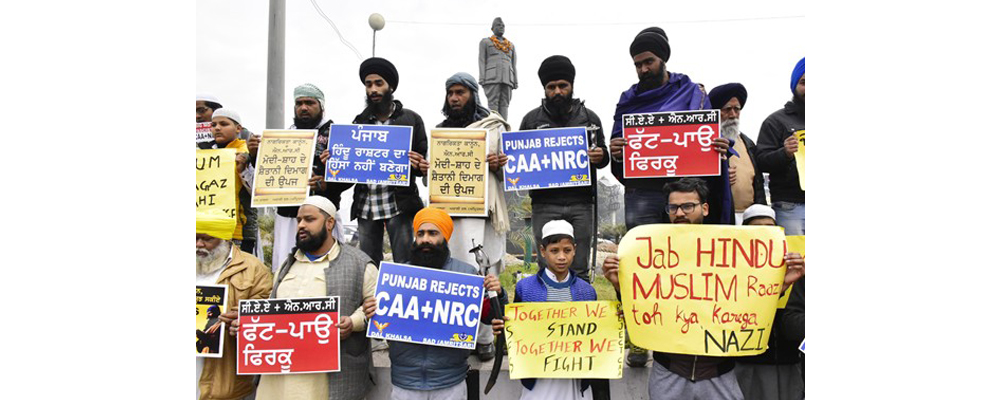
Furthermore, legislation like the Citizenship Amendment Act (CAA) and proposals for the National Register of Citizens (NRC) have stirred deep insecurity. According to The Guardian (2024), the CAA is widely seen as discriminatory because it offers fast-tracked citizenship to non-Muslim refugees from neighbouring countries — effectively weaponising religion as a criterion for belonging in a secular republic.
Everyday Faith Amidst Adversity
For many Muslims, practising their faith is no longer just a spiritual act but also one of quiet resistance. Whether it’s wearing the hijab or skullcap, praying in public, or fasting during Ramadan, these practices have become politicised and viewed with suspicion. What was once routine is now treated as a provocation.
Yet, these expressions of faith continue. According to a 2021 Pew Research report, Indian Muslims are among the most devout communities in the country, with high rates of daily prayer and religious observance. Faith serves as a coping mechanism and a moral anchor in a hostile climate.
At the same time, the shared experience of discrimination has also catalysed new forms of engagement — from grassroots activism and legal literacy drives to interfaith solidarity campaigns. Faith-based resilience is translating into civic action.
The Struggle for Secularism and Belonging
Despite ongoing challenges, Indian Muslims remain deeply committed to the idea of a pluralistic, secular India. Many reject both state oppression and extremist voices within the community. According to the Centre for the Study of Developing Societies (CSDS), Muslim youth today are more likely than before to participate in democratic activism, use legal tools, and demand rights — not as a favour, but as a rightful claim.
While communal tensions grow, so do inter-community solidarities. Secular Hindus, Christians, Sikhs, and people from oppressed castes continue to stand in support of Muslim civil rights. But as laws tighten and rhetoric sharpens, the need for vigilance — grounded in both faith and constitutional values — remains critical.
In Summary
The everyday lives of Indian Muslims today are marked by a dual struggle — material and spiritual. Faith is no longer just a private refuge; it is a public posture of resilience. Linking religious identity to lived realities is essential to understanding how Indian Muslims navigate exclusion, discrimination, and the dream of dignity in a rapidly changing nation.
0 Comments