
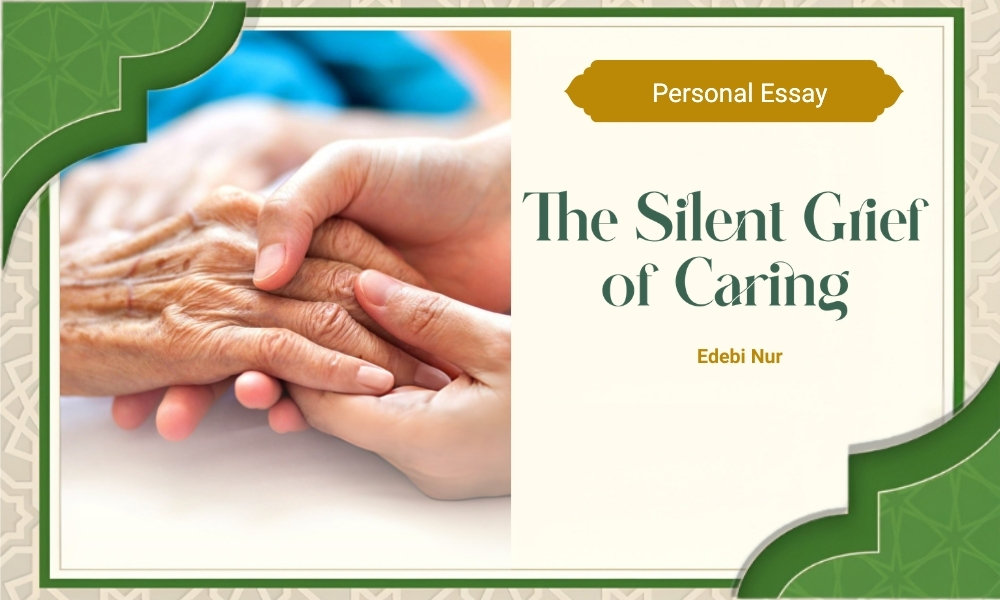
They wake before the alarm. Not because rest has come easily, but because the body has learned vigilance. Even in sleep, some part of the self remains alert listening for a sound, a movement, a need. In the brief stillness before the day begins, there is a pause that feels heavy, though nothing specific seems wrong. It is a weight without language.
By the time the world stirs, they are already functioning. Meals are prepared, medicines measured, schedules remembered, emotions managed. When someone asks how they are, the answer comes reflexively: “I’m fine.” Not always a lie. Just a careful omission.
Caregiving rarely begins as a sacrifice. It begins as love. But love, when stretched across long periods of illness, dependency, crisis, or responsibility, slowly accumulates demands that are not only physical but deeply emotional. Caregivers do not merely do things. They hold emotional space. They absorb fear so others feel safe. They soften grief so it feels bearable. They regulate their own reactions so chaos does not spread. This invisible work, often unnamed even by those who perform it, is emotional labour.
Emotional labour is not a sign of weakness or excessive sensitivity. It is the continuous management of one’s inner world for the sake of another’s stability. Over time, this management becomes exhausting not because the caregiver lacks sincerity, but because emotional energy, like all human resources, is finite.
The Qur’an speaks clearly to this reality:
“Allah wishes to lighten your burden, for the human being was created weak.” (4:28)
Weakness here is not moral failure. It is an acknowledgement of design. A reminder that human beings were not created to carry unrelieved weight indefinitely.
Yet many caregivers do exactly that, often not because they choose to, but because the systems around them quietly expect it.
As care becomes prolonged, something subtle begins to change. Empathy dulls. Patience thins. What once flowed naturally now requires effort. This is compassion fatigue, not the absence of care, but the exhaustion of it. It does not announce itself loudly. It arrives quietly, as numbness, irritability, emotional distance, or a troubling sense of emptiness. Many caregivers respond with guilt, believing they have become ungrateful or spiritually deficient. In reality, their inner reserves have simply been overdrawn.
Alongside this fatigue sits a grief that is rarely recognised. It is not the grief of a single loss, but of many small, ongoing ones. The loss of who a loved one used to be. The loss of imagined futures. The loss of personal freedom, rest, or identity. This grief is ambiguous and continuous, which makes it difficult to name and easy to dismiss. There are no rituals for it. No social scripts. So it remains private, heavy, and unresolved
The Qur’an does not demand the denial of grief. It records it openly. Ya‘qub عليه السلام grieved so deeply that “his eyes turned white with grief” (12:84). His sorrow was not framed as impatience or failure of faith. It was dignified as truth. If prophetic grief was worthy of narration, why is the caregiver’s grief so often expected to remain invisible?
Part of the answer lies in how patience has been misunderstood. Sabr in Islam is not enforced silence or self-neglect. It is conscious endurance supported by meaning, community, and care. What many caregivers are asked to practice instead is suppression, absorbing harm quietly so others remain comfortable. This is not sabr. It is moral misplacement.
Here, the responsibility widens. Families, institutions, and even religious cultures often benefit, sometimes unintentionally, sometimesunquestioningly,d from the quiet endurance of caregivers. Emotional labour is outsourced and then sanctified. Exhaustion is reframed as a virtue. Silence becomes proof of strength. In this arrangement, caregivers are praised, but not protected.
The Qur’an draws a firm ethical boundary against this logic:
“Do not throw yourselves into destruction with your own hands.” (2:195)
This is not only about sudden harm. It is a warning against slow, cumulative self-erasure, especially when it is justified in the name of goodness.
The Prophet ﷺ, whose life was defined by service to others, did not live in collapse. He rested. He withdrew. He tended to his body and soul. He reminded his companions that every right must be fulfilled, including the right of the self.
“Your body has a right over you.”
This was not an afterthought. It was moral guidance.
Care, in Islam, was never meant to be extractive. Mercy was not designed to consume the merciful. When caregivers are left unsupported, compassion itself becomes unsustainable, and what is framed as devotion quietly turns into harm.
To care for caregivers, then, is not an act of kindness. It is an act of justice. It requires more than appreciation; it demands responsibility. It asks uncomfortable questions, especially of those who consider themselves caring: Who is carrying emotional weight so others do not have to? Whose silence makes our lives smoother? What have we come to rely on without ever acknowledging the cost?
Caregivers are not invisible because they lack worth. They are invisible because their suffering has been normalised.
Perhaps the true measure of a compassionate society and a faithful one is not how eloquently it praises those who give endlessly, but whether it notices the moment when giving begins to cost someone their wholeness.
Because care that survives on quiet collapse is not mercy.
And a faith that ignores this is not complete.
Finally found a place that actually gives some decent tips and a fair gaming environment. My winning streak started after I found solusiwinslot. Highly recommended for all slot lovers.