
The writer is an M.Sc. candidate and serves as an educator at Scholars Group of Institutions.
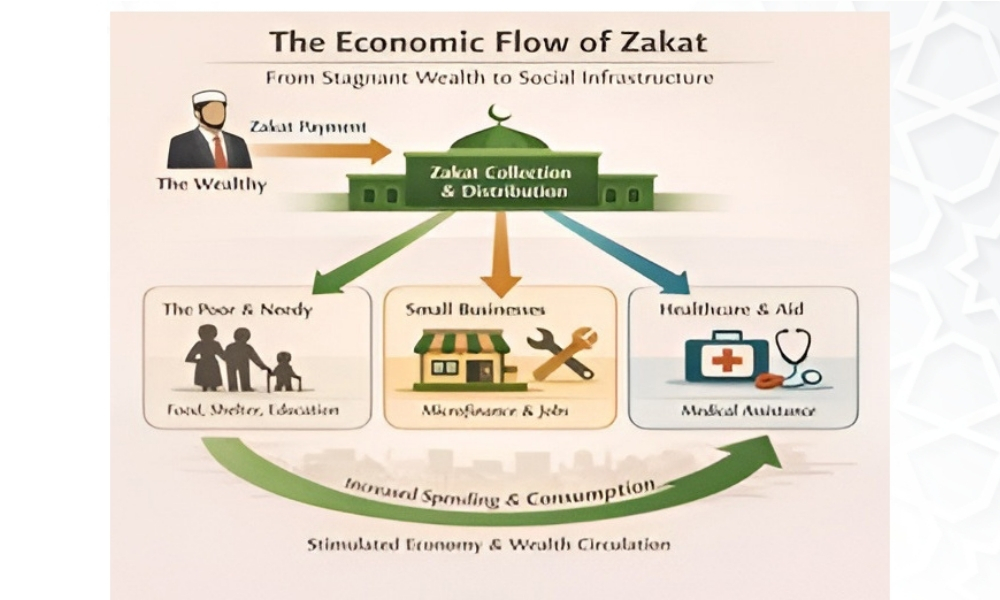
Every Ramadan, conversations about zakat return with familiar urgency. Appeals circulate, donation links multiply, and the faithful respond with open hands. Yet beneath the seasonal generosity lies a deeper question: have we reduced zakat to an annual emotional response when it was meant to function as a permanent social infrastructure? The Qur’an commands, “Take from their wealth a charity by which you purify them and cause them to increase” Qur’an (9:103). Zakat, from its very inception, was designed to be collected, organised and redistributed in a manner that stabilises society.
The Prophet Muhammad ﷺ did not leave zakat to individual calculation alone; he appointed collectors, defined categories, and supervised distribution. The Qur’an itself outlines its recipients in Qur’an (9:60), creating a structured framework rather than a vague encouragement. When zakat has been institutionalised with integrity, Muslim societies have witnessed remarkable cohesion. When it has been left to scattered impulses, its transformative force has weakened. History bears this out with striking clarity.
The Prophetic Foundation and the Early Caliphate:
The early Muslim community understood that wealth circulation was central to justice. The Qur’an warns against economic concentration: “…so that it may not merely circulate between the rich among you” Qur’an (59:7). That verse is as much a social policy principle as it is a moral reminder.
It was under Umar ibn al-Khattab (RA) that zakat moved decisively from personal obligation to organised state system. His establishment of the Diwan created a register of citizens entitled to support. Stipends were allocated with precision. Every newborn child received financial assistance from the public treasury. Zakat collected from Bedouin tribes was returned to their own poor, reinforcing local responsibility and trust. He reportedly instructed collectors not to bring him wealth, but to bring news that poverty had diminished.
Modern historians such as Fred Donner note that the early caliphate rapidly developed fiscal registries and stipendiary systems, indicating that redistribution was embedded structurally, not sentimentally.
This was not a cold administration. Umar (RA) would patrol at night to ensure no household had been overlooked. His governance combined structural order with moral accountability. He recognised that sincerity without systems leaves gaps, and systems without sincerity breed indifference. The two had to walk together.
The Era of Umar ibn Abdul Aziz (RA):
If Umar (RA) laid the institutional foundation, Umar ibn Abdul Aziz (RA) refined it to extraordinary effect.
His first reform was financial purification. He removed unjust taxes that had crept into the system under previous administrations. He understood that redistribution cannot be credible if revenue itself is morally compromised. Public trust flourished because he lived simply and ruled transparently. People did not hide wealth out of fear; they complied out of conviction.
The lesson from his era is not romantic nostalgia. It is administrative clarity. When leadership embodies integrity, and institutions function predictably, zakat becomes an engine of stability rather than a symbolic ritual.
Knowledge, Endowment and the Abbasid Vision:
During the reign of Harun al-Rashid, organised charity was intertwined with intellectual ambition. Baghdad’s House of Wisdom stood as a testament to a civilisation confident enough to invest in scholarship. While zakat and waqf operated through distinct juristic categories, their structured administration created an ecosystem where scholars, translators and students were supported systematically.
A young student from a remote province could travel to Baghdad and find accommodation, stipends and access to books funded through regulated charitable channels. Poverty did not automatically disqualify one from learning. The broader impact was civilisational. Structured giving nurtured knowledge that shaped global intellectual history.
The Ottoman Imaret System:
Centuries later, the Ottoman Empire embedded welfare into the architecture of its cities. In Istanbul and across Anatolia and the Balkans, imaret complexes functioned as integrated social centres. These were not mere soup kitchens. They included mosques, schools, hospitals, guesthouses and public kitchens sustained by carefully documented charitable trusts.
Zakat revenues and waqf endowments were legally structured and supervised. Assistance was delivered discreetly to preserve dignity. Zakat al-Fitr was coordinated before Eid to ensure that festivity did not coexist with hunger. The custom of Askıda Ekmek, where a person would pay for additional loaves to be collected by someone in need, flourished within this culture of organised generosity.
The Ottomans demonstrated that when charity is woven into urban planning and legal frameworks, it acquires permanence. It becomes part of civic life rather than an occasional intervention.
Aurangzeb and Legal Codification in India:
In the Indian subcontinent, Aurangzeb approached fiscal matters with notable precision. Through the compilation of the Fatawa-e-Alamgiri, hundreds of scholars systematised legal and financial rulings across a vast empire. Zakat collection was separated from military taxation, reducing the risk of charitable funds being absorbed into political expenditure.
Merchants transporting goods between Delhi and Bengal were protected from arbitrary double taxation. This maintained commercial flow while ensuring obligations to the poor were fulfilled. Codification reduced ambiguity, and ambiguity is often where corruption hides. His approach illustrated that legal clarity is itself a form of social justice.
Modern Models of Transparency:
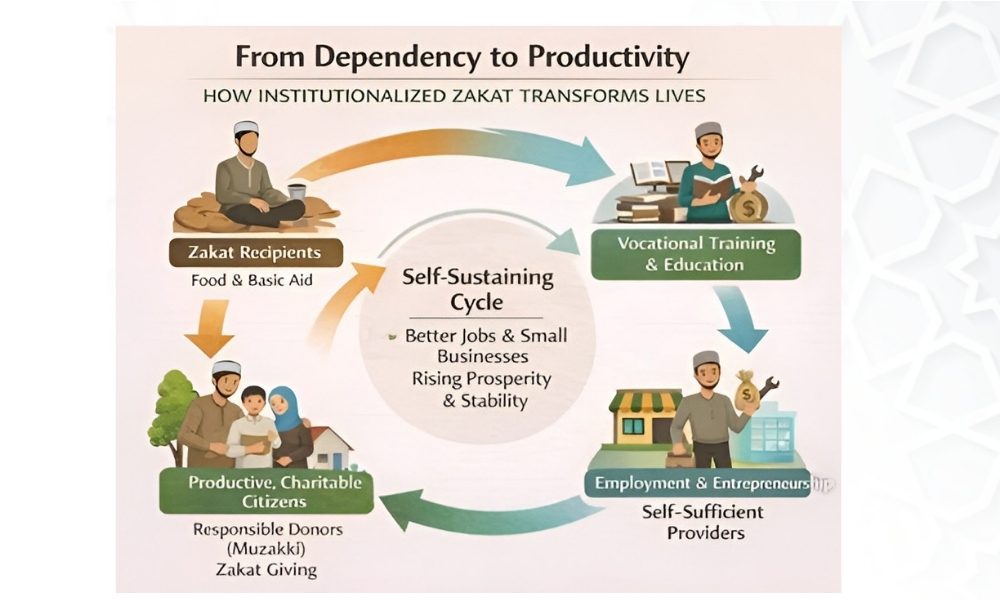
The relevance of institutionalisation is not confined to history. In Malaysia, organisations such as Lembaga Zakat Selangor operate with centralised databases, audited financial statements and strategic allocation of funds. In recent years, Lembaga Zakat Selangor has reported annual zakat collections exceeding RM 1 billion (approximately £180 million), underscoring the scale that structured administration can achieve. Beneficiaries receive vocational training, business tools and educational support. Many transition from recipients to contributors within a few years. Transparency builds compliance, and compliance strengthens the system.
In Singapore, the Majlis Ugama Islam Singapura administers zakat with meticulous documentation. Majlis Ugama Islam Singapura has, in recent disclosures, collected more than S$50 million annually (around £30 million), funding education grants, housing aid and community welfare programmes. Annual reports are detailed and publicly accessible. Funds are channelled into education grants, housing support and healthcare assistance. In a minority context, credibility is essential. The system does not merely alleviate hardship; it interrupts generational poverty.
Similarly, in Indonesia, Badan Amil Zakat Nasional integrates zakat into national poverty strategies. Digital platforms widen participation, and audited reports reinforce trust. Structured empowerment replaces episodic relief.
Janab Abul A’la Maududi argued that zakat must operate under organised authority to fulfil its Qur’anic purpose. Fragmented committees and informal transfers, however sincere, cannot address structural inequality. Zakat in his vision was part of an Islamic socio-political framework designed to prevent wealth concentration and social alienation.
The ethical necessity of documentation, data and measurable planning must be emphasized. Without coordination, some areas receive overlapping assistance while others remain neglected. Institutional professionalism is not a concession to modernity but a fulfilment of amanah.
Allama Iqbal expressed the moral urgency of economic justice in unforgettable lines:
“Jis khet se dehqaan ko mayassar na ho rozi,
Us khet ke har khosha-e-gandum ko jala do.”
(Burn every ear of wheat from that field which does not provide the farmer with his daily bread.)
He was challenging complacency in the face of injustice. Wealth that does not nourish society betrays its purpose. Zakat exists to correct that imbalance.
One does not have to look only at large national foundations to see structured zakat at work. In several parts of Kerala, mosque-based committees and coordinated community networks have quietly developed disciplined systems over the years. In many towns, surveys are conducted before Ramadan to identify eligible households. Beneficiary lists are verified locally, duplication is carefully avoided, and zakat funds are maintained separately from other charitable collections. Financial summaries are often shared with congregations, strengthening confidence between donors and administrators. Increasingly, assistance is directed towards education, medical treatment and small livelihood support rather than one-time cash distribution. It is not a state-enforced system, nor is it identical everywhere, but it demonstrates something vital: institutionalisation begins with record-keeping, accountability and a sense of collective responsibility.
Within India, the Dawoodi Bohra community demonstrates the impact of coordinated welfare. Community members are carefully documented. Financial assistance is discreet and proactive. Needs are identified before desperation becomes visible. In many Bohra localities, public begging is virtually absent. This is not the result of isolated charity, but of structured communal responsibility.
Ramadan and the Renewal of Systems:
Ramadan intensifies generosity, but it should also inspire institutional renewal. Zakat has always been more than an annual disbursement. It is a mechanism designed to circulate wealth, purify society and uphold dignity. The Qur’an does not merely call for compassion; it outlines categories, principles and accountability.
The golden ages of zakat were not accidents of piety. They were achievements of the organisation. If contemporary Muslim societies aspire to similar impact, they must invest not only in giving more, but in building better structures: accurate registries, transparent audits, trained administrators and long-term strategies.
As this Ramadan approaches, perhaps the greater act of devotion lies not only in writing cheques, but in strengthening the institutions that will carry those funds responsibly. Zakat has already proven its power across centuries. The question before us is whether we are prepared to treat it once again as the social infrastructure it was always meant to be.
References:
Islamic Law and Constitution by Abul A’la Maududi

0 Comments