
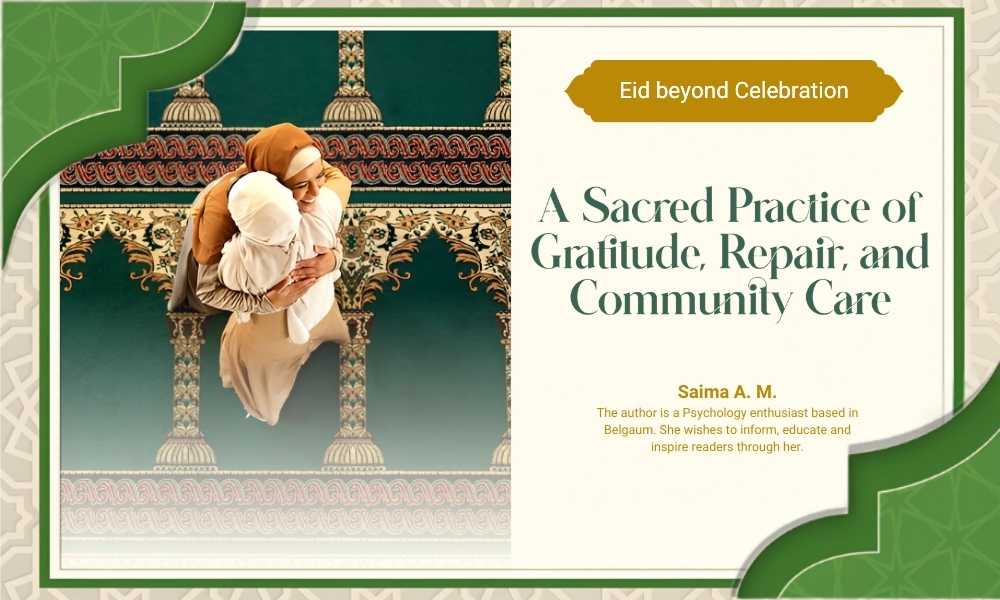
The author is a Psychology enthusiast based in Belgaum. She wishes to inform, educate and inspire readers through her
The crescent appears, and Muslims around the world mark the end of Ramadan. We prepare for Eid – new clothes, hearty meals, traditional delicacies and desserts. Children run excitedly around the streets, greeting “Eid Mubarak”. But is Eid merely supposed to be a celebration? Or is it something beyond that, like a divine opportunity for gratitude and service to the community?
Islamic festivities, as we celebrate, are not merely cultural holidays. They are moments that allow believers to heal their hearts and strengthen their community. Most of us tend to view Eid as a day of journey and greetings. Let’s understand what we can do so we can reap the benefits and achieve the purpose of Ramadan. Let’s broaden this view and understand how Islam teaches us about integrating religion, well-being, and social responsibility.
The Qur’an clearly states that the goal of Ramadan is “ لَعَلَّكُمْ تَتَّقُونَ ” — so that we cultivate “Taqwa”, meaning piety or God-consciousness. It is the state of obeying what Allah has ordered and refraining from what He has forbidden. During Ramadan, Muslims are trained intensively to achieve this state. On the occasion of Eid, we are thus responsible for building life on the foundation laid during the training period.
Eid as the foundation of gratitude
At its core, Eid is an expression of gratitude to Allah. Eid is a celebration that marks the end of fasting and completes the spiritual journey. So we thank Allah for having guided us throughout. “He wants you to complete the prescribed period and to glorify Him for having guided you, so that you may be grateful” (Qur’an 2:185). This verse shows the significance that the celebration at the end is not “ coincidental”. It is a deliberate placement that serves as a testimony—an acknowledgement that we were strong enough to endure the fasts and that we are blessed upon completion.
Prophet Muhammad ﷺ would only have some dates (in odd numbers) before going to the Eid prayer, as a symbolic gesture that Eid isn’t an act of indulgence. His focus remained on thankfulness and responsibility.
Repair: Healing Collectively
Eid is not merely a celebration of joy; it focuses on cultivating gratitude. This is done by the act of “ repair”— purification of one’s spiritual well-being. This practice of repair begins with the self, integrating the entire month’s teachings into daily living. Beyond one’s individual repair, Eid also creates a moment for healing relationships and mending the broken bonds. Visiting family and friends, exchanging greetings and seeking forgiveness from those we may have wronged—all this reflects the reconciling nature of Eid, transforming it into a collective achievement.
Community Care as Worship
The concept of community care in Islam is a manifestation of inner gratitude and healing. Think of it like a mechanism — a way through which the worship done during the entire month, can be validated and transformed outward. So, how exactly does community care start? It starts within oneself. To care for others is to be that example. It is to create a cycle of goodness, simply by embodying change within oneself. One will then be able to become steadfast, applying the one-month training throughout a lifetime of servitude to the Creator. When community care and support are strong enough, believers find greater fulfilment and inner peace, leading to collective happiness.
This shared effervescence of Eid creates a remarkable bond that strengthens individuals’ sense of belonging. Islam has never eliminated “celebration”; it has redirected it towards the recognition of a greater purpose and the cultivation of gratitude.
From Intention to Action
Currently, when individualism and consumerism are at their peak, we must rediscover the purpose of Islamic celebrations. Understanding the goal is one thing, but knowing how to achieve it is another. Although everyone has their own path to their goals, here are some easy steps to get started
- Plan your days intentionally. Treat time like a treasure, grabbing every opportunity for doing what’s been expected of a believer. Allot time for Prayers, Qur’an, Dhikr, and community service.
- Prepare a personal action plan during Ramadan that you can follow even after that.
- Spend time daily with the Qur’an, not just recitation, but also engaging with meaning and reflection.
- Ask the Almighty for forgiveness consistently. Plead in prostration before Him.
- Give some charity—according to one’s own capacity—beyond money (like food, old clothes, books, etc.)
There are many more good deeds, but one can start simply. These small steps lead to a greater destiny. Understanding that filling life with good deeds eventually removes the bad ones. Think of Eid as the day when we are given the gift of a purified heart, a steadfast will, and a renewed faith. Eid is not the end of a month; it is the beginning of a much more mindful life. Our task is to protect the gift and build upon it: it is to celebrate and to commit.
0 Comments