
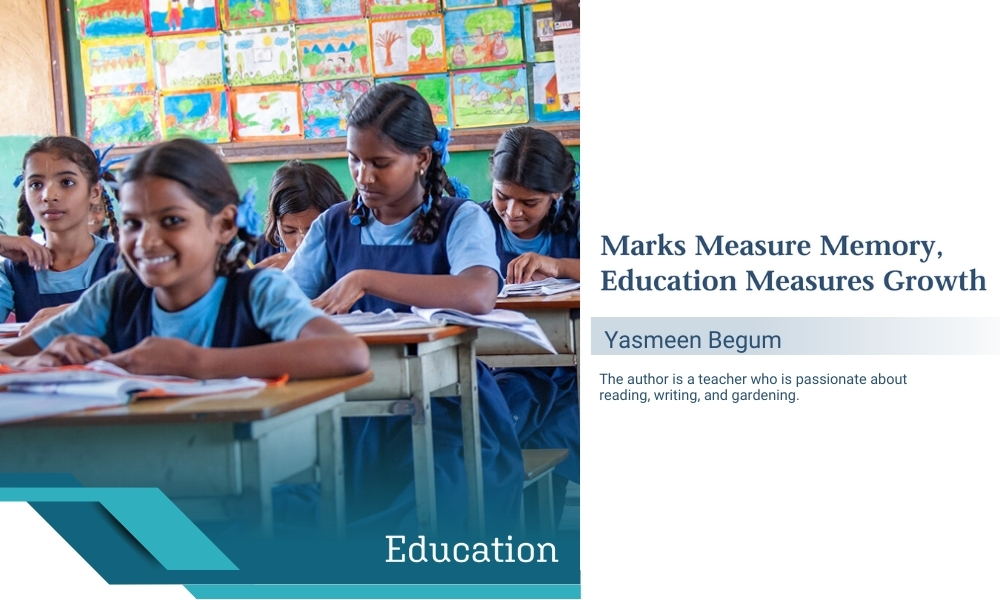
The author is a teacher who is passionate about reading, writing, and gardening.

Classroom — the place where the future is laid out, where the young are molded and crafted to their finest abilities, and where careers are made. The most important people in this whole process are the teachers and students. Nevertheless, it lies in the hands of the teacher to make a child a fully developed personality or make him a no one in the face of the world.
Beyond all these facts, there is a pressure that hangs upon both the student and the teacher — completion of syllabus, expectations from the organization, staff, and parents — all on the teacher’s plate. Meanwhile, the student is surrounded by over-expecting parents, told to memorize and complete the portion to be learned, perform well, and grow into an error-free, perfect individual.
But real education has a different and more empathetic angle toward students. It talks about learning that is not just about scoring high marks in exams, but about shaping a child’s mind, character, skills, empathy, and curiosity.
Education Beyond Marks
Education is not confined to textbooks or exam papers. It is the light that helps us understand the world, make good decisions, and build meaningful relationships. True education teaches us how to think, not just what to write. It nurtures creativity, problem-solving, confidence, kindness, and responsibility. Marks may open doors, but character decides how far we go. When we learn to communicate well, respect others, lead with honesty, and continue seeking knowledge, we grow into strong and capable human beings. Education is successful not when students score high, but when they learn to become thoughtful, caring, and independent individuals.
Can Empathy and Character Become Core Learning Goals in the Future?
Yes, it is a real possibility. The traditional model of education, focused on rote learning and standardised testing, is being challenged by the complexities of the 21st century. The entry of AI into our lives has drastically changed educational tools, testing systems, and other aspects of life. Due to rising mental health issues, schools have given education new roles — teaching socio-emotional well-being and becoming more supportive and inclusive toward students.
Conclusion
The future of learning is not just about producing better test-takers or more efficient teachers. It is about nurturing better humans — individuals who can navigate a complex world with compassion and wisdom. While the challenges are real, the direction is clear. Empathy and character are not “nice-to-have” add-ons; they are foundational competencies for a thriving, sustainable, and equitable future. Making them core learning goals is one of the most important investments we can make in our education systems.
In the end, I must say, it’s not about making school soft, but about making it complete.
“The future will not only ask how much we know, but how deeply we care.”
0 Comments