
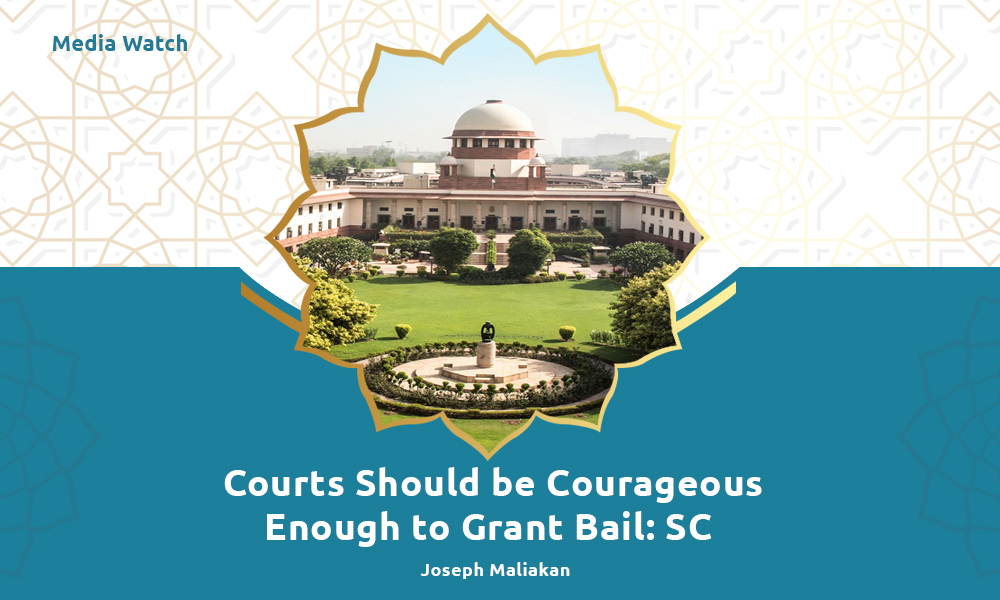
Granting bail to a Muslim Cleric Syed Shad Kazmi, arrested 11 months ago under the draconian Uttar Pradesh Prohibition of Unlawful Conversion of Religion Act 2021, the Supreme Court on 20 January ruled that judges on their whims and fancies cannot deny bail to any accused saying that conversion is something very serious. Instead, judges should show courage to grant bail, the Supreme Court said.
A bench of the Supreme Court comprising Justices J.B Padiwala and R. Mahadevan said the matter should not have reached the Supreme Court. “ We can understand that the trial court declined bail as trial courts seldom muster the courage to grant bail, be it any offence. However, at least, it was expected of the High Court (Allahabad) to muster the courage and exercise its discretion judiciously, “ the order pointed out.
After hearing both sides, the SC bench observed, “We believe that the High Court should have exercised its discretion by granting bail to the petitioner. There was no good reason for the Allahabad High Court to decline bail. The offence alleged is not that grave like murder, decoity, rape etc.”
Soon after the Uttar Pradesh Prohibition of Unlawful Conversion of Religion Act 2021 was passed, critics said that the law would be extensively misused against religious minorities. The law said that if the conversion is of a minor, scheduled caste, scheduled tribe or a woman, the guilty will face a jail term of three to 10 years and a fine of Rs. 25,000. In the case of mass conversion ( conversion of more than two persons is ‘ mass conversion ‘ according to the law), the guilty will face a jail term of three to 10 years and a fine of Rs.50,000.
The law violates Article 25 (1) of the Constitution, which guarantees to every citizen the freedom of conscience and free profession, practice, and propagation of religion, subject to public order, morality, and health, and not merely to the followers of one particular religion.
The order further said that year after year, many conferences, workshops, and seminars are held to educate trial judges on exercising their discretion while considering bail applications. The reluctance of the trial judges to grant bail even in highly deserving cases leads one to the conclusion that the trial judges do not understand the scope of Section 439 of the Criminal Procedure Code ( CrPC ) or Section 483 of the Bharatiya Nagrik Sureksha Samhita (BNSS).
The SC further said, “At times when the High Court declines bail in matters of the present type, it gives an impression that altogether different considerations weighed with the presiding officer ignoring the well-settled principles of the grant of bail.” What harm would have been done if the petitioner was released on bail?”, the Supreme Court judges wondered.
“This is one of the reasons why the High Courts and now, unfortunately, the Supreme Court also are flooded with bail applications,” the bench added. Though the trial is in progress in this case and the prosecution witnesses are being examined, it is a fit case to order the release of the petitioner on bail subject to the conditions that the trial court may deem fit to impose. With the latest order on bail by the Supreme Court, one hopes will make trial court judges courageous enough to grant bail to thousands of undertrial prisoners languishing in Indian jails for years.
Undertrial prisoners constitute 75.8 per cent of prisoners in Indian jails. The jails are also overcrowded, with 131.4 per cent occupancy. Further, 60 per cent of the inmates are either illiterate or come from marginalised sections of society. Scheduled castes, Scheduled tribes and Muslims constitute the majority of the prison population.
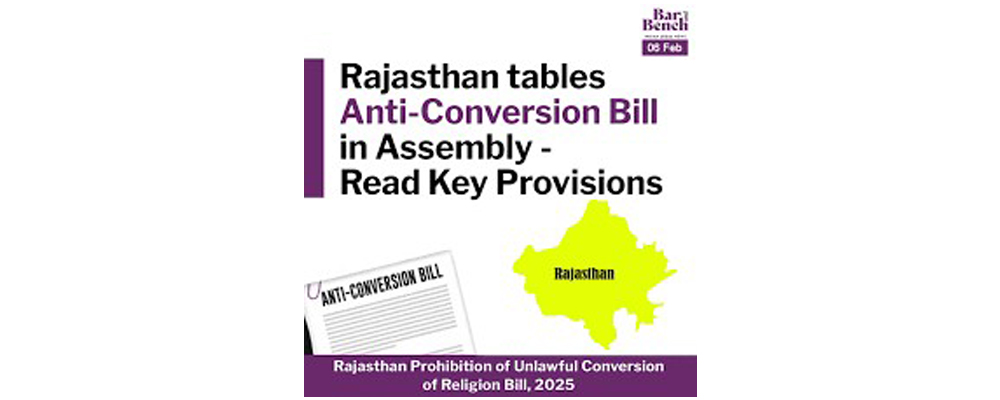
If passed, the Rajasthan Prohibition of Unlawful Conversion of Religion Bill, 2025, tabled in the Rajasthan Assembly on 4 February 2025, will turn the criminal jurisprudence upside down. According to criminal law as practised in India, an accused is presumed innocent until proven guilty.
However, under the Prohibition of Unlawful Conversion of Religion Bill, “ the burden of proof that a religious conversion was not carried out through misrepresentation, force, undue influence, coercion, allurement, or fraudulent means or marriage lies on the person who has “caused” the conversion, that is the accused. This is a reversal of the practice of the presumption of innocence of the accused.
Ironically, the statement of Objects and Reasons for the Bill says, “ The Constitution confers on each individual the fundamental right to profess, practice and propagate his religion. However, the individual right to freedom of conscience and religion cannot be extended to construe a collective right to proselytise; the right to religious freedom belongs equally to the person converting and the individual sought to be converted.”
It added that many examples of conversion through fraud and misrepresentation have recently come to light. “The law related to the right to religious freedom already exists in various states of the country, but there was no statute on the said subject in Rajasthan,” it added.
In 2006, the government claimed that “The state government has observed that some religious and other institutions, bodies and other individuals are found to be involved in Unlawful Conversion from one religion to another by allurement or by fraudulent means or forcibly, which at times has annoyed the community belonging to other religions. Such illegal activities weaken the inter-religion fabric and cause law and order problems.”
The Bill was returned without assent by the then President of India, Pratibha Patil, following criticism by Human Rights groups and minority groups who argued that the law was being brought to harass minorities.
The President did not consent to an amended version of the Bill in 2008, either. When Vasundhara Raje became Chief Minister of Rajasthan for the second time (2013 – 2018), she tried to make the 2008 Bill law. The President returned the Bill in 2017, saying it “deviated from the National policy.”
What is very shocking about the 2025 Bill is that all offences under the Bill are proposed to be made COGNIZABLE and NON-BAILABLE. Any undergraduate law student will know that this provision is unconstitutional. Only on 20 January 2025, a bench of the Supreme Court of India comprising Justices JB Padiwala and R Mahadevan granted bail to the Muslim, Syed Shad Kazmi, arrested under the Uttar Pradesh Prohibition of Unlawful Conversion of Religion Act. 2021, said, “We are of the view that the High Court ( of Allahabad ) should have exercised its discretion by granting bail to the petitioner. There was no good reason for the High Court to decline bail. The offence alleged is not that grave like murder, decoity, rape etc.”
Another very draconian provision in the Bill is that it provides blanket protection to government officials, including the police, against any legal proceedings for anything done in pursuance of the proposed law.
Section 13 of the Bill, “ Protection of action taken in good faith,” protects authorities from any adverse action against them. Government officials and the police in our country are known for arbitrary and high-handed behaviour towards the common person, and this blanket protection will only lead to increased harassment of ordinary people.
“No suit, prosecution, or other legal proceedings shall lie against any authority or officer for anything done in good faith or intended to be done or purported to be done, or omitted to be done in pursuance of this Act, or any rule or order made thereunder”, says the Bill.
The Bill specifically targets inter-religious marriages. If a marriage is found to have been carried out for the sole purpose of religious conversion, it can be annulled by the family court. The Bill defines “ love jihad “ as a marriage conducted with the intent of converting a person’s religion. The legislation also has provisions for very strict punishment for the conversion of minors, women and people from the scheduled castes and Scheduled Tribes.
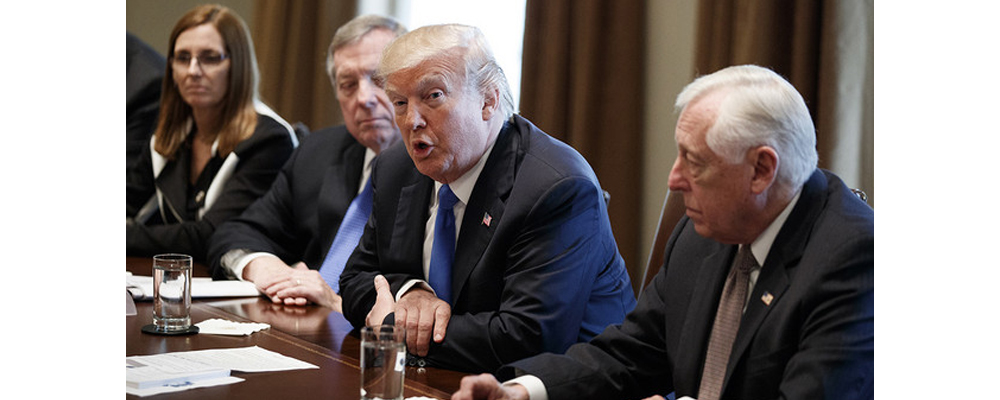
Trump’s inauguration ceremony in the US Capitol on 20 January was marked by the presence of some of the richest men in the world. On the crowded dais were Elon Musk, a former democrat who spent a quarter of a billion dollars for Trump’s election, Meta’s Mark Zuckerberg, Amazon’s Jeff Bezos, Europe’s wealthiest man Bernard Arnault, India’s Mukesh Ambani and Apple Chief Executive Tim Cook. They were joined by billionaire Cabinet nominees Howard Lutnick (Commerce) and Scot Besment ( Treasury nominee ).
Lutnick, in a speech on Monday at the Capital One Arena, where Trump’s supporters had gathered to watch the swearing-in, said, “ The man is power.” Musk spoke after Lutnick and said he would help Trump usher in a “ golden age in America “ to thunderous applause.
Commenting on the spectacle, the Democratic National Committee said that by “ leaving his supporters literally out in the cold while billionaires worth more than $1 tn got a front-row seat,” the President was showing he would always “ put himself and his ultra-wealthy backers ahead of the American people .”
The American people got a taste of Trump’s illegal actions on his first day in office. He signed a flurry of executive orders overriding orders the outgoing Biden administration issued. On 21 January, President Trump’s executive order to end birthright citizenship faced legal challenges from several states and civil rights groups.
A coalition of 18 states filed a lawsuit in Massachusetts saying the birthright citizenship executive order violates the constitutional rights of thousands of children and imposes undue costs on local jurisdictions that would lose federal funding tied to Medicaid and children’s health insurance.
In addition, the American Civil Liberties Union and the Lawyers for Civil Rights filed separate legal challenges in New Hampshire and Massachusetts for parents whose children would not be eligible for citizenship under Trump’s order.
“ Denying citizenship to U.S.-born children is not only unconstitutional – it is a reckless and ruthless repudiation of American values,” said Anthony D. Romero, Executive Director of the American Civil Liberties Union, in an interview with the Washington Post.
On Thursday, a federal judge temporarily blocked President Trump’s executive order to end automatic citizenship for babies born on American soil. In a hearing held on Thursday, Federal District Court Judge John C Coughenour agreed with four states that used.
“This is a blatantly unconstitutional order …I have difficulty understanding how a member of the bar would unequivocally state this is a constitutional order”, he told Trump administration lawyers.
Trump’s scrapping of sanctions on violent Jewish extremists in the occupied West Bank came as dozens of settlers on 19 January rampaged through the Palestinian village. The lifting of sanctions means that President Trump has decided to take a strong pro-Israeli stand in the conflict between Israel and Hamas.
Trump also restored sanctions against the International Court of Justice, which has issued arrest warrants for Israeli Prime Minister Benjamin Netanyahu and his former Defence Minister “ for crimes against humanity and war crimes.”
A Trump decision to suspend all US foreign aid for 90 days will also adversely affect Palestinians since US donations form a big share of the budget of various aid organisations.
During his first administration, Trump had declared the Jewish settlements in the West Bank as legal, recognised Israel’s claim to the Syrian Golan Heights and unveiled a peace initiative that assigned the majority of the contested city of Jerusalem to Israel. Trump has described the Israeli-Palestinian conflict as a real estate dispute! In the White House on inauguration day, he said about Gaza and the West Bank: “ It is a phenomenal location, on the sea, with the best weather, and some beautiful things can be done with it.”
Within hours of taking over as the 47th President of the United States on Monday, 20 January, Trump granted pardons to more than 1 500 of his supporters who stormed the Capitol in a bid to stall congressional certification of Joe Biden’s election victory. He also commuted the sentences of 14 far-right Proud Boys and the Oath Keepers Militia members.
Three federal judges on Wednesday strongly condemned President Donald Trump’s sweeping pardons of the supporters who stormed the US Capitol four years ago in an attempt to overrun the results of the 2020 election.
“No pardon can change the tragic truth of what happened on 6 January 2021 “, District Judge Tanya Chutkan said in an order dismissing charges against a Capitol riot defendant.
“It cannot whitewash the blood, faces and terror that the mob left in its wake, “ Chutkan said. “ And it cannot repair the jagged breach in America’s sacred tradition of peacefully transitioning power.”
Chutkan presided over the criminal case filed against Trump by special counsel Jack Smith, accusing him of seeking to overturn the results of the 2020 election. The case never came to trial, and it was dismissed after Trump won the November election, in line with a long-standing Justice Department policy of not prosecuting a sitting President.
Two other Washington-based federal judges who presided over cases involving Capitol riot defendants also dismissed the charges on Wednesday with strongly worded condemnations of the pardons.
“No ‘national injustice’ occurred here, just as no outcome – determinative election fraud occurred in the 2020 presidential election”, Howell said, adding that “poor losers” cannot be allowed to disrupt the peaceful transfer of power with impunity”.
“That merely raises the dangerous sector of future lawless conduct by other poor losers and undermines the rule of law,” she said.
District Judge Colleen Kollar-Kotelly said the dismissal of charges and pardons “will not change the truth of what happened on 6 January 2021.”
“What occured that day is preserved for the future through thousands of contemporaneous videos, transcripts of trials, jury verdicts, and judicial opinions”, Colleen Kollar-Kotelly said.
“Those records are immutable and represent the truth, no matter how the events of January 6 are described by those charged or their allies.”
Trump has repeatedly played down the violence of January 6, even describing it as a ‘day of love’. More than 140 police officers were injured in hours of clashes with rioters wei, including flagpoles, baseball bats, hockey sticks and other makeshift weapons, along with Tasers and canisters of bear spray.
0 Comments