

I must admit, I was eagerly awaiting a flood of stories about your dining escapades with family and friends, but alas, it seems many of you were too busy savouring the moments to write about them. A heartfelt thank you to those who have joined me on this delicious journey of food and togetherness!
As we enter March, we also enter Ramadan, a time of reflection, devotion, and some truly memorable meals. So, as we embark on a special month of Ramadan, let’s celebrate the food and the spirit behind it. And, of course, I’d still love to hear your dining-out tales—drop
Ramadan also transformed the house’s women into early birds and night owls. If they weren’t waking before dawn to prepare suhoor, they stayed up for night prayers, running on an energy source that still baffles me. The day began with kneading dough at my parents’ house because fresh rotis were necessary. Qeema and curd were staples, while rice made only rare appearances. And amid all this, my mother, the true force behind it all, barely got five to ten minutes to eat her suhoor, a quiet sacrifice that spoke volumes about her love and dedication.
Marrying into a culturally different joint family came with its fair share of surprises, but nothing, absolutely nothing, prepared me for the Great Suhoor Shock. At my parents’ home, rotis were the undisputed kings of pre-dawn meals. Here? Not a single roti in sight! Instead, the table groaned under the weight of rice, dal, moringa leaf curry, papad, and a crispy non-veg dish—a delicious spread, yes, but a complete betrayal of my roti-loving soul. Determined to uphold my flour-based legacy, I made some for myself on the first day. No problem. On day two, my husband casually mentioned he wouldn’t mind some rotis either. Like the devoted wife I was, I obliged. By day three, a brother-in-law hopped on the bandwagon, followed swiftly by another, then my father-in-law, and before I knew it, I was running a full-fledged, pre-dawn roti enterprise. By the sixth day, as I stood in my makeshift midnight bakery, flipping chapatis for an ever-expanding clientele, a life-altering realisation hit me: rice is amazing. From then on, I wholeheartedly embraced the family tradition… and never looked at a suhoor roti again.
After suhoor, the next thing on everyone’s mind, sometimes within minutes, was iftar. It was a day-long anticipation, a countdown of sorts. I still remember my husband’s golden advice: “Never go shopping before iftar in Ramadan; you’ll end up buying things you won’t even eat!” Wise words were spoken from experience and ignored by me at least once (with regrettable results).
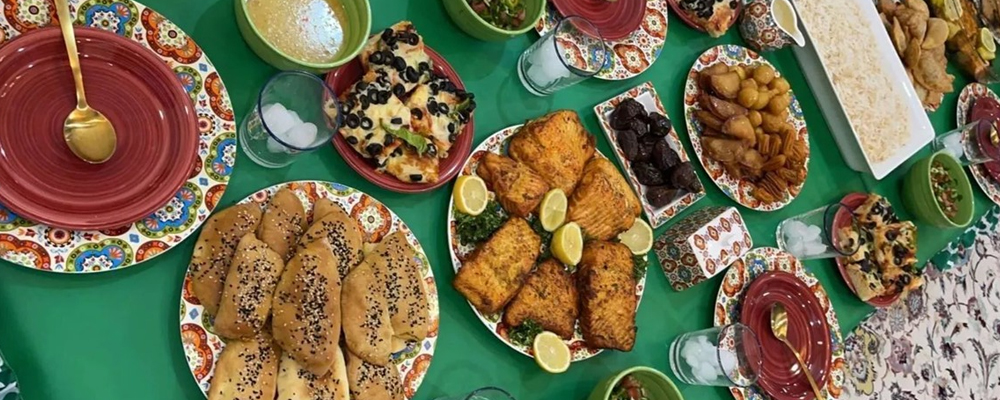
Our iftar table was a glorious spread of neatly sliced or cubed fruits, the ever-present Rooh Afza, and the undisputed star of the show: samosas. My brother, in his infinite wisdom, had an amusing classification system. According to him, the crispy, qeema-filled samosas were “Muslim samosas,” while the potato-stuffed ones were apparently “Non-Muslim samosas.” Culinary stereotypes, but undeniably funny!
Every Indian Muslim kitchen has its iftar staple; if Hyderabadis swear by haleem, back home, our Ramadan regular was Aash, a comforting porridge of rice or soji-moong dal, mildly spiced and enriched with minced meat. Though Ammi made it at home, my brother was convinced that the superior version could only be obtained by braving the long queues at the local masjid, which was cooked in massive cauldrons and generously shared with Muslims and non-Muslims alike. My in-laws, however, had their take on porridge, a sweet version made by tempering onions in ghee with cardamom, cashews, and roasted semolina, then slow-cooked in coconut milk with just the right balance of salt and sugar. While I could never quite develop a taste for it, I did manage to achieve something far greater; I converted my entire in-laws’ family into die-hard Aash lovers!
One year, in the spirit of adventure, our family decided to ditch the usual iftar routine and head to the Ramadan Food Mela. The plan was simple: break the fast with dates and water, then launch ourselves into a feast of epic proportions. Easy, right? Not. The moment we stepped into that aromatic battlefield of sizzling grills, fragrant curries, and an endless sea of snacks, my brain and stomach locked horns in a brutal standoff, paralysed by the sheer magnitude of choices. When I finally picked something, I felt like I had survived an emotional marathon. What is the moral of the story? Never underestimate the decision fatigue of a hungry foodie at a Ramadan feast!
And then there were the iftar parties, and one memory, in particular, still makes me smile. Before I started fasting regularly, my first ‘Iftar’ get-together was an adventure. Ammi handed me a small steel tiffin that dangled from my wrist like a tiny purse and sent me off to the nearby masjid with my cousins and brother. Her only instructions? “Wait for the azaan and share!”, a test of my foodie instincts if there ever was one. Sitting in a long row of children across a dastarkhwan (dining space), I dutifully passed around bits of roti and leafy vegetables. But then something magical happened; my once-empty tiffin lid transformed into a vibrant platter of flavours, colours, and aromas. That’s the beauty of Ramadan: the more you share, the richer your plate becomes!
Iftar parties were well-planned and neatly categorised based on the guest list. One evening was strictly for relatives; another was reserved for professional iftar meet-ups, each with its vibe, menu, and level of chaos. Once again, the women transformed into superwomen, seamlessly juggling kitchen duties, guest hospitality, and last-minute food plating while running on an empty stomach. Their dua time? Sacrificed at the altar of table-setting, floor-arranging, and ensuring every guest (including the tiny, floor-seated brigade of children) had a plate before the azaan. Truly, if multitasking were an Olympic sport, Ramadan-hosting women would bring home the gold every single time!
As kids, we eagerly await the familiar knock before iftar, signalling a plate or bowl from our generous neighbours. The joy of receiving was only matched by the joy of giving. It was a beautiful cycle of kindness, where even the simplest meal felt like a feast. We still continue to share (of course, sometimes with anticipation of not getting our plates empty!).
The iftar table is a scene of contrasts; some look ready to faint, and others glow as if fasting was effortless (still unsure if that’s real or just great acting). Mothers dart between the kitchen and table, forgetting their dishes and waking up the one family member who would spend the entire day sleeping. At the same time, siblings argue over who’ll clean up until an elder wisely reminds everyone to make dua instead. Then there’s the accountant, secretly counting and dividing food in their head to ensure a fair share for all. And just as the azaan echoes, a mad scramble begins for the little Ramadan calendar because the iftar dua is only remembered for this one month!
While Ramadan is fundamentally about spiritual growth and self-discipline, let’s not pretend food doesn’t stand out in the experience. After all, iftar tables are where culinary traditions shine, and patience is rewarded! And speaking of patience, let’s take a moment to applaud the real superheroes of this month—the women of the house. From the crack of dawn (Suhoor) to the moment the Maghrib call to prayer signals Iftar, they are in a league of their own, multitasking with a grace that defies the laws of physics.
0 Comments