
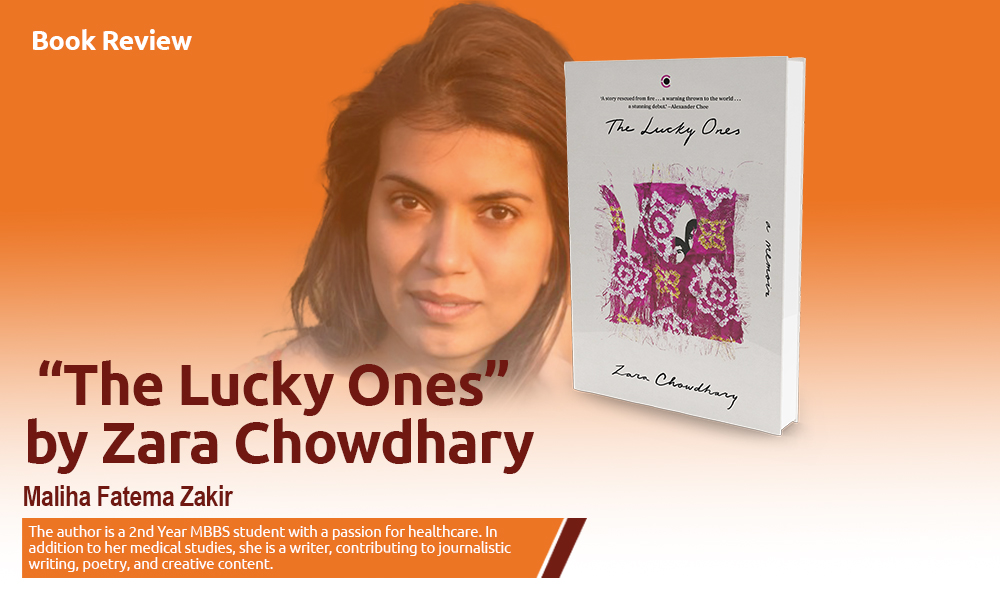
The author is a 2nd Year MBBS student with a passion for healthcare. In addition to her medical studies, she is a writer, contributing to journalistic writing, poetry, and creative content.
Zara Chowdhary’s The Lucky Ones is not just a book—it’s a piercing testimony, a mosaic of pain, resilience, and survival intricately woven with the delicate threads of identity and belonging. Set in Gujarat, a land of vibrant culture and history, the book opens a window into a reality that many overlook: the story of Gujarat’s Muslim communities. Once I read this book, it struck a chord with me for several reasons. First, it’s set in Gujarat, and as a Gujarati, I loved how it brought Ahmedabad to life—mentioning iconic places like the Sabarmati and capturing the essence of the region. What made it even more special was its portrayal of a Muslim family.
As a Muslim Gujarati, I rarely come across books that weave together both these identities, making it deeply relatable for me. Often, when people talk about Gujarat, they overlook its Muslim communities. There’s a prevalent misconception that Gujaratis are a monolith, but this book breaks that stereotype by highlighting the presence, culture, and rights of Muslim Gujaratis. It’s refreshing to see a narrative acknowledging this often-ignored aspect of Gujarat’s diversity.
The brilliance of Chowdhary’s writing lies in its authenticity. The prose is not dressed in flowery perfection but carries the rawness of lived experiences. It feels like sitting across from a friend pouring out their heart—every word pulsating with unfiltered emotions.
Chowdhary captures the raw essence of a community reeling from the aftermath of the 2002 Gujarat riots—a tragedy that scarred generations and left indelible marks on the Muslim identity in India. The vivid descriptions of Ahmedabad, from the Sabarmati River to the winding streets of Khanpur, breathe life into the pages. Yet, the familiar sights are marred by the shadows of history, of bloodstained streets and silenced prayers.
What stood out to me next was the poignant description of Ahsan Jafri. The way the writer captured his essence and how his legacy would be remembered was truly beautiful. And not just him but others too. This book isn’t just a story—it’s an emotional journey. It brought tears at several points, especially for those who’ve grown up hearing about the riots from their parents and grandparents or reading accounts of those dark times.
The book resonates deeply with anyone familiar with these stories, vividly portraying the destruction—the burnt and ruined homes—and the collective rebirth of Muslim communities in Gujarat. It reflects how, after the riots, people had to start from scratch, rebuilding their lives and identities.
Even now, the situation of Muslims in Gujarat remains far from ideal. The social standing and influence they once held before the riots—positions of respect and prominence—have significantly diminished. This book doesn’t just recount history; it also holds up a mirror to the enduring struggles of these communities.
One of the most heart-wrenching aspects of the book is how it seamlessly ties personal grief with collective suffering. The vivid imagery of burnt homes, desecrated neighbourhoods, and broken dreams brings to life the trauma that the Muslim community endured. Lines like “Gandhi and my grandfather died early, and I find it good because they died swiftly, the death was smooth, not like this madness” encapsulate the depth of despair that pervades the narrative.
Chowdhary doesn’t merely recount events—she delves into the psyche of a community forced to rebuild itself from ashes. She portrays how Gujarat’s Muslims were once a thriving, respected community but have since been pushed into the margins, ghettoized, and silenced. The book forces readers to confront the harsh reality of Islamophobia, not just as isolated incidents but as a systemic issue deeply embedded in society.
The intense Islamophobia, ruthless killings, rapes, and murders described in the book were overwhelming—I had to take breaks, feeling broken, hurt, and angry. The vivid portrayal of Partition and Ahmedabad’s history added layers of emotion and depth, making the narrative even more poignant. It felt like history unfolding before our eyes, too close and too real. The poem about “Papa at Work” shattered me in countless ways, leaving behind the haunting question of who to blame—a mystery that remains unsolved.
The emotional weight of The Lucky Ones is further amplified by its poignant reflections on identity. Chowdhary explores the duality of living as a Muslim in Gujarat: the constant fear of being “othered,” the whispered salams in public, the hidden hijabs and trimmed beards—all measures to avoid drawing attention in a world that views their identity with suspicion. The bitter reality of madrassas being labeled as breeding grounds for hate highlight the everyday struggles of a community fighting to preserve its dignity.
I loved how the author described the shift in India’s ideologies—from being tolerant to increasingly intolerant.
This is the reality of how India has changed, and how we, as Muslims in India, have been reduced to a state of constant fear, like a quivering cat relying on the mercy of God. We live in apprehension every day, haunted by the words and actions that target us. Despite everything, we continue to believe that things can change. We trust in our India, in our Constitution, and we remain steadfast in our faith. My grandfather and father, who stayed and built their lives here, are examples of this enduring hope, like so many others.
What fascinated me most about the book was how the writer began by describing her old, normal routine—the behaviour of her family, her own habits—and then transitioned to the events of 2002. This contrast made the narrative deeply relatable.
For instance, she talks about her aunt, someone who was fiercely supportive and bold, embodying qualities often attributed to men. Similarly, the description of each journalist, including Madina Shaikh, as courageous and strong, adds layers of emotion to the story. These portrayals evoke a stronger connection, making the reader feel the weight of the events even more.
The writer masterfully relates ordinary family relationships, routines, and aspirations—things that resonate universally. Even if you weren’t a direct victim, sitting safely at home, you can’t help but empathize. You realize that people just like you, with similar dreams and routines, were the ones deeply affected, their lives upended. This connection between the ordinary and the tragic is what makes the narrative so impactful.
Next up the writer also focuses on issues apart from the massacre like for example, she writes “When will my mother remember the warrior she was meant to be and save herself?” This story about her mother and grandmother struck me deeply, highlighting the strength and resilience of women. It paints a vivid picture of the potential women possess, even in domestic spaces. Looking at the women in society, it feels like they’re capable of so much more than their current roles.
The book’s charm lies in its attention to detail—even the history behind names. Normally, such details might seem dull, but here, every word feels purposeful. Not a single page felt boring or skippable, making it an engrossing read throughout.
The historical and political commentary woven throughout the book is both enlightening and haunting. Chowdhary traces the shift in India’s ideologies, from a nation that once prided itself on tolerance to one grappling with growing divisions. The comparison to the Hijrah—the forced migration of Prophet Muhammad (PBUH) and his followers—is particularly poignant, drawing parallels between historical and modern struggles for survival and dignity. It hit hard, highlighting how many had to undergo their version of Hijrah—a journey of immense difficulty and sacrifice.
This passage profoundly impacted me, capturing the stark divisions within India. The contrast between girls from affluent backgrounds—attending expensive dance classes and flaunting their privilege—and the auto-rickshaw girls from the old city highlights the class divide. It reflects how mimicry of wealth’s “plastic sheen” might offer some a way out, though most remain grounded in their reality, facing disdain for their cultural differences, like the smells of their chicken samosas and mutton rolls amidst militantly vegetarian peers.
The narrative goes beyond the Partition, shedding light on a deeper fragmentation—an India split into upper and lower classes, Hindu-Muslim divides, and two worlds with entirely different struggles. It’s as though the pain of one side is invisible to the other. Their lives brim with malls, restaurants, and theatres, while others remain hunkered in their homes, their losses unnoticed.
The imagery of two different Ahmedabads, two Gujarats, and two Indias separated by a river-turned-permanent divide is heartbreaking. The indifference of one side to the other’s reality—unwilling to see, let alone fight for it—makes the lines all the more powerful, exposing the enduring fractures in our society.
Chowdhary’s words are not just a lament for what has been lost but a rallying cry for what can still be salvaged. Her portrayal of the Muslim community’s resilience in the face of unimaginable adversity is a reminder of the strength that lies within us all. For those who live as minorities anywhere in the world, The Lucky Ones is a mirror reflecting their struggles, fears, and unyielding hope.
The book ends on a note that is as empowering as it is heart-wrenching: “Some days, when it feels like my motherland is forsaking me, telling me I am not hers, she is not mine… I remind myself that my belonging was bequeathed to me by the best of mothers: my amma. She lost a child, a chance at love, a life of freedom. But she chose Misba and me to empty herself into. We own everything that is great and beautiful and redeemable about our country.”
This book has motivated people like me to write as if the world might finally listen to the cries of little innocent girls. Though our voices may seem feeble and unremarkable, they hold the potential to intrigue and resonate.
In The Lucky Ones, Zara Chowdhary has penned more than a novel—it is a plea, a protest, a prayer and a testament to the struggles, sacrifices, pains, and wounds she endured. It’s as if someone, silenced for so long, was finally handed a pen, and she wrote with unrelenting emotion, refusing to hold back.
It is a book that demands to be read, remembered and acted upon. For anyone who has ever felt unseen, unheard, or unworthy, this book is a testament that their story matters, their pain matters, and their hope is worth holding onto.
0 Comments