
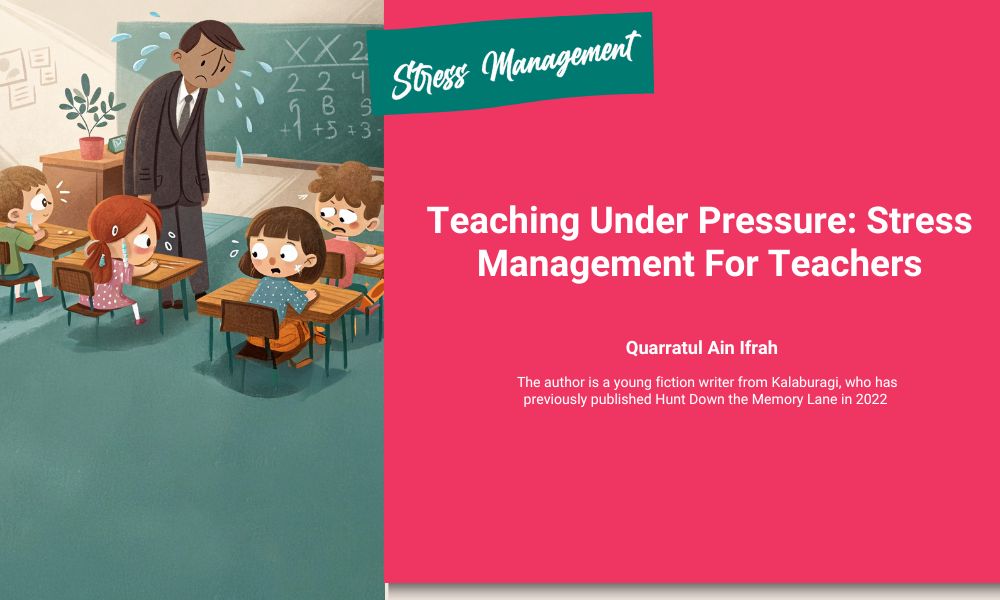
The author is a young fiction writer from Kalaburagi, who has previously published Hunt Down the Memory Lane in 2022. This article has previously appeared in Radiance Viewsweekly.
A 2024 cross-sectional study in Tamil Nadu found 74.3% of teachers responding as high perceived stress, in a similar one in January 2025 of 234 university teachers in Kerela, 84% reported moderate to high stress. Another pandemic-era study (Godbole et al 2021) reported 32% stress prevalence, while most pre-2020 studies report lower ‘high stress’ rates.
Once a child is admitted to school, parents are free to use the teacher’s name on all communications, and management can employ the person for any tasks inside or outside the classroom. It is therefore unsurprising that there is a rise in “stress” among these teachers. Stress is the state of imbalance between the demands placed on the individual and his/her ability to handle them. Any task that is beyond the individual’s resources is deemed stressful, and the resources can be physical, mental, or material.
The teacher has to handle excessive workloads in very high time constraints, and almost erase the line between personal and professional life. He/she must appear calm and encouraging before the student, consistently suppressing their own emotions, and present themselves as a figure of authority, a close friend, and a reliable source for each student and their parents, whether it is exam day, a school picnic, or regular lessons. AI and technology have created a sudden generation gap between teachers and students. Meanwhile, administrative policies change so frequently that the training a teacher receives today is inadequate by the next month.
Dr. Gomathi Jain, an associate professor at the Centre of Excellence in Teacher Education (CETE), TISS, Mumbai, says that AI has started making educators feel irrelevant as it is being perceived as a replacement. Students’ overdependence on AI and the reduced engagement with learning resulted in increasing teacher’s workload as they have to spend more time in verifying the originality of students’ assignments or responses.
The Consequences
The part that makes stress intolerable and disables the person from doing any other task is, of course, its aroused state. The human body is designed for survival, and anything threatening its survival is a cause of stress. It does not differentiate between the sight of a tiger or an important work deadline, so any stressful event pushes the body into a fight or flight state, which is characterised by high heart rate and BP, tensed muscles, digestive issues or sleep disturbances. The aroused state uses up all of the body’s energy sources, and if the body is under stress for a long time, it eventually shuts down. The individual faces chronic fatigue, and at one point, the mental processes dysfunction as well. Concentration, memory, mood swings and feelings of frustration arise. The person may then depend on the use of substances like excess coffee, drugs, tobacco or alcohol to cope. He begins to avoid more responsibilities and simply exists, helpless and overwhelmed, leading to increased stress in the future, and the cycle continues.
In the classroom, such a teacher experiences a kind of depersonalization, adopting a very resentful and alienated attitude towards the students. This leads to less empathetic interactions and a reduction in job satisfaction, motivation, and general productivity.
Although a limited amount of stress is necessary for growth and productivity, stress becomes harmful only when this limit is crossed unreasonably, and the individual is expected to perform beyond their abilities. Harmful to the extent of death.
Short Term Solutions
So if unchecked stress is that fatal, then it is not only necessary but immediately vital to understand how to manage stress. The NCERT teacher’s survey 2023 found that 79% of the teachers disagreed with the statement “working as a teacher is stressful”, but almost all of them continued to describe the symptoms of stress and burnout in the qualitative comments. This shows that a majority of teachers do no self-identify as stressed. Why is that? Prejudice towards the term “stressed” as it indicates professional weakness in a way. The first step, then, is to understand that it is not so. Stress is simply the body’s signal of overheating, and all we require to do is to attend to the signal.
Stress management may require different methods, depending on the extent and nature of the stress. For instance, direct problem solving can be used if the stressor is addressable, while emotion-focused management can help change negative emotions if the event is out of control. Cognitive reframing allows a person to shift their outlook to a more positive one, perceiving the same event as a challenge or opportunity instead of a threat, thereby reducing stress.
Some instant techniques like deep breathing/box breathing, Grounding exercises (5-4-3-2-1), or brain dumping can help to provide immediate relief in the middle of a stressful situation by calming the body and reminding it that you are still in control. Still, if the stressor or event is likely to be long-term and extend over years, it requires a complete change in lifestyle and mindset to adapt.
Some instant techniques like deep breathing/box breathing, Grounding exercises (5-4-3-2-1), or brain dumping can help to provide immediate relief in the middle of a stressful situation by calming the body and reminding it that you are still in control. Still, if the stressor or event is likely to be long-term and extend over years, it requires a complete change in lifestyle and mindset to adapt.
Long-Term Solutions
On a personal level, this may include seeking relief in religion and spirituality, Regular physical exercise, a healthy diet and a sleep schedule that prepares the body for future stress and reduces its effects. At the same time, mental activities such as engaging in hobbies, reading, emotional expression and social interaction may strengthen the mind and its ability to deal with stress. Time management is also a major factor in stress prevention, as more than half of the pressure arises from a lack of time to complete a given task.
But institutionally, there is a need for creating a conducive environment, a sort of peer group that makes space for support and encouragement rather than a place for conflict and pressure. Dr. Gomathi Jain also suggests AI-focused training programs that help the teachers to perceive AI as a partner than as a threat.
Dr. Ali Khwaja, a counsellor and life skills coach from the Banjara Academy, while describing the measure to take against stress says that we need to bring down the focus and constant pressure of tests and exams. The teachers should be trained and trusted to evaluate students continuously. Completion of portions should not be mandatory and teachers should be allowed to initiate a discussion and brainstorming on each subject and take the views of different students. They should be given facilities to improve their physical and mental health – counselling should be available to any teacher who is showing any signs of stress.
Stress is inevitable, and for teachers who carry the weight of so many futures, acknowledging stress is not weakness; it is wisdom. We need to strive to not only eliminate stress, but also recognise it and respond to it in the way it requires.
We’ll written content, concept of stress made clear through basic theories.
Scope can be extended to details and methodologies to equip the teachers to deal with the new generation students.
Very insightful article.