

The author is a well-known veteran journalist.
The death of six Muslims in Sambhal, Uttar Pradesh, on Sunday, 24 November 2024, was the result of the illegal order of the Sambhal civil court in violation of the Places of Worship Act 1991, a law that froze the status of all religious places as they were on 15 August 1947, the date on which India became independent.
In light of the 1991 Act and the 2019 Supreme Court order in the Babri Masjid-Ram Janma Bhoomi case, the Sambhal civil court should not have considered the petition claiming that the Shahi Jama Masjid in Sambhal is built on the ruins of a temple demolished by Babar, the founder of the 16th-century Mughal Empire.
The petition filed by Advocate Harishanker Jain in the court of Civil Judge Sambhal claimed that a survey by experts could lead to the discovery of the remains of the destroyed Harihar Temple. Although the Shahi Jama Masjid in Sambhal was a functioning mosque, the Hindu Nationalist group Akhil Bharat Hindu Mahasabha claimed that the Muslims stopped praying there decades ago.
Muslims have used the Shahi Jama Masjid in Sambhal for almost 500 years. However, on November 19, the Sambhal civil court, without even notifying the mosque’s Managing Committee, ordered a survey of the Mosque to look for the remains of a temple on its premises!
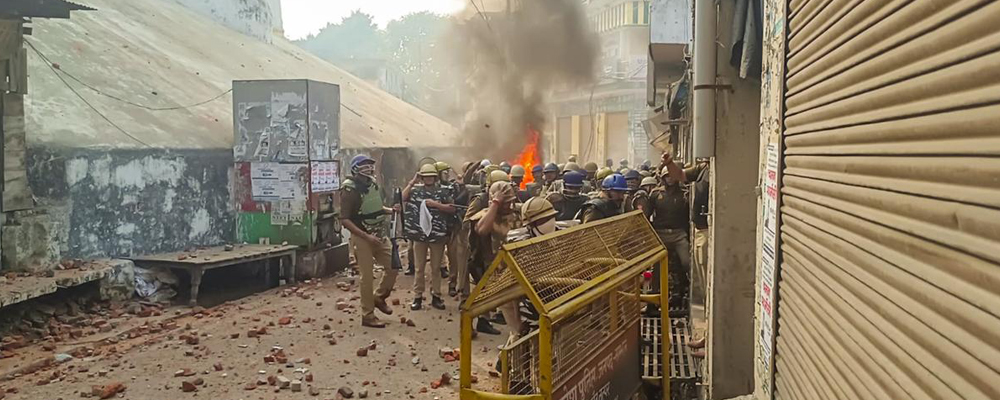
In a tearing hurry, on the same day, a team of U.P government ‘experts’ surveyed the mosque, looking for ruins of the Hindu temple. When, on Sunday, 24th November, the team returned to the Mosque for a second survey without notifying the Mosque management, the local Muslims resisted.
As the police tried to disperse the protesting Muslims, violence erupted, and police opened fire, killing six Muslims and injuring scores of people, including some policemen in stone pelting. Sambhal’s peace was destroyed because the judiciary failed to uphold the rule of law under the Indian Constitution.
One is reminded of the incidents in Ayodhya. A year after the passing of the 1991 Act protecting places of worship, a Hindu mob encouraged by the top leadership of the Bharatiya Janata Party pulled down the 16th Century Babri Masjid in Ayodhya. The destruction of the Babri Masjid led to communal violence in different parts of the country in which some 2000 people were killed.
Hindu groups had claimed before the destruction of the Babri Masjid that the Masjid stood at the very spot where the Hindu deity Ram was born. In 2019, the Supreme Court of India awarded the land where Babri Masjid stood to Hindus and ordered that in future, the Places of Worship Act 1991 will be strictly enforced and no claims of any place of worship belonging to any religion, Hindu or Muslim will be entertained by any court of law.
Therefore, the local civil court was legally and constitutionally bound to reject the Hindu groups’ claim that a Hindu temple existed where the Sambhal Jama Masjid stood. However, various Hindu groups have been filing petitions in different courts claiming that many Mosques in the country were built on the sites of razed Hindu Temples. Courts have been too willing to order a survey of Mosques to find Hindu temples.
The Hindu groups have prepared a list of more than 3000 mosques that have been built after the demolition of temples. In the future, we can expect Hindu groups to file more petitions in courts nationwide.
There is already a dispute over the Gyanvapi Mosque in Varanasi, the Eidgah Masjid in Mathura, and the Kamal-Mulla Masjid in Dhar, both in Uttar Pradesh. There is yet another dispute over the Kamal-Mulla Masjid in adjoining Madhya Pradesh.
As if these were not enough, on 27 November, a civil court in Ajmer issued notices to the Ajmer Dargah Committee, the Union Ministry of Minority Affairs, and the Archeological Survey of India after Vishnu Gupta, the national president of the Hindu Sena, filed a petition claiming that the Dargah was originally a Shiva temple.
Commenting on the developments regarding the Ajmer Dargah, Syed Sarwar Chisty, Secretary of the Anjuman Syedzadgan, the representative body of caretakers of the Dargah, told newspapers: “We swallowed a bitter pill after Babri Masjid and accepted it in the interest of the nation, believing that something like that won’t repeat. But Kashi, Mathura, Sambhal … it refuses to stop.” On December 12, hearteningly, a Supreme Court bench, led by Chief Justice of India Sanjiv Khanna, barred courts from passing “effective orders” in cases related to the Places of Worship Act till further orders.
0 Comments