
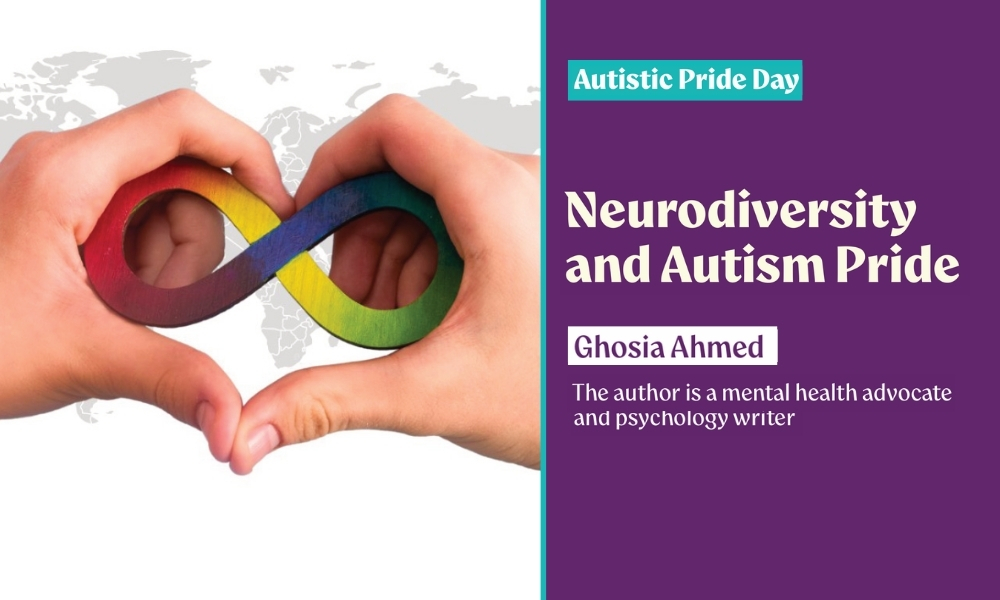
The author is a mental health advocate and psychology writer
They are not abnormal; they are just differently normal.
The Different Painting
Mama, why does my palette have different colours?
When I see white, the others feel blue.
When I see red, the others feel green.
Why is my painting so different from theirs?
Dada, why is their “normal” so strange to me?
What I see, they fail to understand.
What they see, I am never able to find.
You ask me to be “normal,” but which “normal” do you mean?
I don’t understand.
Why do you hesitate to introduce me to new faces?
I also love to make friends.
I have my own colours to share, and paintings to paint.
Why do people look at me so differently?
Do I not look good enough to be seen?
Why does the world seem so noisy sometimes?
Why do they hear my voice as a harsh noise?
Why does this earth always look different to me?
Why is understanding people such a heavy burden?
Do I not belong here?
The Island Analogy
Imagine you get stuck on an island. The terrain is completely strange to you. You are terrified, lonely, and desperate for help. You cry out to the people passing by, but most of them simply ignore you. You have no choice but to keep calling out.
When a few people finally stop to look at you, you try to tell them that you are scared, that you are lost, and that you need help—but they cannot understand a single word you say.
How would you feel at that exact moment?
Helpless. Irritated. Uncomfortable. Frustrated. Lonely.
You would feel as though this is a world where you do not belong. This is almost the exact same struggle that neurodivergent people face every single day. And the people ignoring them? That could be you and me sometimes. The only difference is that you eventually get to go back to your familiar world, while they have to spend their entire lives on that strange island.
But the question is, why do we ignore them? Is it because they can harm us? No. In reality, they are the ones who are most easily harmed by society.
In ancient times, before humans were fully civilized, they were easily frightened by anything unfamiliar. They decided whether to accept or reject something purely based on fear. Centuries later, humanity became educated and intelligent enough not to fear the unknown anymore.
Education brings acceptance. This article is a must-read for everyone. Our willingness to self-educate and accept others can build a kinder society; one where every “uniquely normal” individual has equal value and the right to exist.
People often bluntly slap a single label on every neurological difference. However, all of these variations are completely different and require distinct types of care and support. In this article, we will break down some of the major neurodivergent conditions.
- Autism Spectrum Disorder (ASD)
Under current diagnostic standards, different types of autism have been merged into a single “spectrum.” Today, autism is classified by Severity Levels based on how much daily support an individual needs.
Level 1: Requiring Support
These individuals are often casually referred to as “high-functioning.” They can speak in full sentences and communicate well, but they face clear challenges with social cues, planning, organizing, and switching between tasks.
You might find these individuals struggling to understand other people’s emotions, or even failing to express their own. This difference starts early; even as toddlers, they may not naturally respond to the warmth of a parent’s hug or cuddle. While most neurotypical toddlers adjust their bodies comfortably when held, an autistic child might hold their body stiff and straight.
When interacting with them, remember to be direct about what you need. Clarity is kindness.
Level 2: Requiring Substantial Support
These individuals have noticeable difficulties with both verbal and spoken communication. Their social interactions are very limited or atypical, and repetitive behaviors or extreme distress during changes in routine are obvious to anyone around them.
Communicating with them is a true art form. Imagine living a life where your mind is full of things to say, but you are trapped inside a silent cage, unable to get the words out.
Level 3: Requiring Very Substantial Support
These individuals face severe communication barriers; many are completely non-verbal or use very few words. They experience intense distress when their daily routines change, and highly repetitive behaviors significantly impact their ability to function.
Thanks to modern technology, some individuals now use specialized digital devices to express their needs. Unfortunately, not every family can afford these expensive tools.
Historical Classifications
Though these terms are no longer given as official new diagnoses, they are still widely used within the community as personal identity markers:
Asperger’s Syndrome: Characterized by typical or advanced intelligence and language development, combined with significant challenges in social interaction and body language.
Pervasive Developmental Disorder-Not Otherwise Specified (PDD-NOS): A category used for individuals who displayed some autistic traits but did not fully meet the strict criteria for classic autism.
Autistic Disorder (Classic Autism): Diagnosed when individuals showed significant delays in early speech, deep social barriers, and intense sensory processing differences.
Childhood Disintegrative Disorder (CDD): A rare condition where children develop perfectly normally for several years, and then experience a severe reversal, losing their social, communication, and motor skills.
I remember a distant relative of mine who had a daughter. After turning 20 maybe, she began losing her functional skills. By the end of her life, she was acting like a one-year-old baby.
- Other Main Branches of Neurodiversity
The neurodiversity perspective views human brains as functioning along a wide spectrum of natural variations, categorized by how they process information:
How the Brain Focuses and Plans (Attention & Executive Functioning)
Attention-Deficit/Hyperactivity Disorder (ADHD): Differences in the brain’s chemical pathways that affect focus, impulse control, and organization.
We have all seen kids (and even adults) with seemingly endless energy. They jump from couches to chairs, start tasks impatiently, and lose interest within minutes. Some struggle immensely to concentrate in a classroom, no matter how many times they are scolded for daydreaming. Parents often label this behavior as just being a “naughty kid,” but the condition runs much deeper.
To better understand it, we must look at its specific types:
- Inattentive Type: Challenges primarily involve focus, memory, and organization (historically called ADD). These kids are not hyperactive or disruptive; they simply have a very short attention span, which makes schoolwork incredibly difficult. Teachers and guardians need creative strategies to keep them engaged.
- Hyperactive-Impulsive Type: Characterized by physical restlessness, constant movement, and hasty decision-making. These individuals thrive on high energy. The more you try to restrict them, the more chaotic things become. Slow, repetitive routines bore them completely; they need constructive outlets to release their energy.
- Combined Type: Features a mix of both inattention and hyperactivity.
In 2022, I worked at a school where I encountered a 14-year-old boy with ADHD. Meeting him made me truly realize the vital importance of early diagnosis, community awareness, and the massive impact this condition has on teenagers and adults. Let’s look at the remaining conditions first, and then I will share his story.
Specific Learning Differences
Dyslexia: Differences in how the brain processes sounds and language, affecting reading speed, decoding words, and spelling. Children with dyslexia struggle to recognize written words. There is a beautiful Bollywood movie (Taare Zameen Par) that perfectly captures this condition. Imagine someone putting a gun to your temple and demanding you read a page of Chinese text that you cannot comprehend. Imagine that intense anxiety. Children are often left with no choice but to mentally check out or run away from their studies. They are not unintelligent; they simply need specialized teaching methods to thrive.
Dyscalculia: A learning difference that affects a person’s ability to grasp numbers, numerical patterns, and basic math. Simple calculations are not simple for everyone; for some, basic arithmetic is a grueling riddle that drains their energy.
Dysgraphia: A neurological variation affecting fine motor skills, making the physical act of handwriting and organizing thoughts on paper incredibly difficult. These individuals do not just have “bad handwriting”, they are actively fighting a real neurological barrier.
Body Movement & Communication Conditions
Developmental Coordination Disorder (DCD / Dyspraxia): Affects physical coordination, spatial awareness, balance, and motor planning. Everyday tasks like tying shoelaces, riding a bicycle, or buttoning a shirt feel like monumental challenges.
Tourette Syndrome: A neurological condition characterized by chronic, involuntary physical movements (motor tics) and vocal sounds (vocal tics). The Indian film Hichki beautifully highlights this syndrome, showing that the true struggle isn’t the condition itself, but rather a society that refuses to accept anyone who looks or acts a little different.
Social (Pragmatic) Communication Disorder: A condition where individuals struggle specifically with the unwritten, social rules of spoken language, without showing the repetitive behaviors or intense focus areas seen in autism.
Genetic Profiles
Down Syndrome (Trisomy 21): A genetic condition caused by an extra chromosome 21. It creates a distinct, lifelong form of neurodivergence, shaping an individual’s physical traits, developmental timeline, and unique learning style. These individuals are easily recognizable, often sharing beautiful common traits like almond-shaped eyes, distinct facial features, and unique hand patterns.
(References: American Psychiatric Association: DSM-5-TR / World Health Organization: ICD-11)
The Boy from the School
When I started working at that school, I encountered hundreds of children, all with different personalities and energy levels. Among them was a 9th-standard boy who had been universally labeled by the staff as the most misbehaving, dumb, and disrespectful kid in the institution. He was infamous among the teachers.
Breaking rules and doing prohibited things was the only way his hyperactive body knew how to release its trapped energy. Even when frustrated teachers threw him out of the classroom—which was exactly what he wanted, since the classroom felt like a jail sentence to him—he couldn’t sit still. He would endlessly pace the hallways.
If you think that was the peak of his ADHD, consider the extremes his impulsivity reached: once, purely looking for a burst of excitement to channel his energy, he intentionally started a physical fight with a large group of senior boys. Another time, he provoked a classmate so relentlessly that it ended in a violent altercation.
Eventually, his chaotic behavior became too much for the administration to handle. The school decided they had no choice but to expel him.
When his parents were called in, I saw that they were thoroughly decent, ordinary people. His mother, visibly stressed, mentioned that even at home, if he had nothing to do, he would pace their small rooms endlessly or compulsively clean and cook in the kitchen just to keep moving. The parents were completely clueless about how to raise a child like this. Because his constant urge for high-stimulation excitement was never managed, he had started slipping into dangerous habits unsuited for his age, like smoking secretly and looking up inappropriate content online.
The school issued his Transfer Certificate (TC), and he was sent away.
I still wonder: will any regular school ever truly understand a boy like him? Especially in a country like India, where schools desperately need trained psychologists, yet school boards give the least importance to counseling positions. Even if elite, expensive schools have the specialized professionals required to help these children, can average parents ever afford them?
What will happen to him?
What does his future hold?
Will his potential just be thrown away?
And if he is lost to the system, how many thousands of other children are silently drowning in that exact same system right now?
My dear readers, the vast majority of our society is still completely blind to these conditions. Moving from basic awareness to actually learning how to support these individuals is our vital next step. By opening our minds, we can build a world where all minds can coexist equally.
Too often, people give cold, judgmental stares to parents when a neurodivergent child experiences a meltdown or doesn’t conform to societal standards in public.
Try to imagine their world. Imagine the parents’ constant fears, their exhaustion, and their hidden pain. Those judgmental glances make them feel deeply guilty, as if they have committed a crime simply by raising their child.
Many of these neurological conditions are incurable, but they can be beautifully managed with the right support, patience, and training. As previously mentioned, every condition comes with its own unique set of needs and requests. Diagnosing it early, understanding it deeply, and never losing hope for these children is what matters most. Together, we can create a safe, compassionate space where they can grow into highly capable individuals.
Too often, society falsely views these children as slow, unintelligent, or hopeless. Yet, if we simply learn how to understand and handle their unique wiring, their potential is absolutely limitless. There are many other examples of people who created history with their conditions because there was no one who told them they were weaker or abnormal.
Take Greta Thunberg, for example. Greta is openly autistic and has obsessive thoughts. When she was a child, she learned about pollution and the global warming crisis. Her deep focus led her to ask her parents to stop traveling by airplane to protect the environment—and her parents completely supported her, never letting her down. In 2018, at the age of 15, she boldly started her solo school strike, launching the global movement known as “Fridays for Future.” In the beginning, she stood entirely alone without support, but her sheer persistence left an undeniable mark on the world.
Greta frequently refers to her autism as her “superpower.” She has publicly stated that being on the spectrum helps her see the world in black and white when it comes to the climate crisis, allowing her to stay intensely focused on the facts without getting distracted by social pressures or political compromise.
Her unique biological wiring didn’t hold her back; instead, it gave her the intense focus and motivation to keep fighting without getting discouraged. Today, she is a fearless, fierce, and highly influential global leader who is transforming millions of lives. We owe a massive salute to her parents, who chose to see her strengths rather than labeling her based on her different way of functioning.
A kind pat on the shoulder, a reassuring smile, or just a little more public tolerance can give these families the breathing room they desperately need.
It is time for professionals and anyone with authentic knowledge about neurodiversity to step forward and educate the public.
“Because this world does not belong to just one type of mind. This world belongs to everyone.”
DID YOU KNOW?
— Autism Facts
Autism is called a “spectrum” because experiences and support needs vary widely from person to person.
Many autistic people may be highly sensitive to sounds, lights, textures, or crowded environments.
Early support and inclusive education can significantly improve confidence, communication, and daily functioning.
Autism is not caused by vaccines — extensive scientific research across multiple countries has disproved that claim.
Best official site I have encountered so far. The customer service is responsive and they help you out with any issues quickly. Trust coklat777resmi for sure.
[2478]Bdok – বাংলাদেশে সেরা ক্যাসিনো গেম, লগইন, রেজিস্টার এবং অ্যাপ ডাউনলোড,Bdok-এ আপনাকে স্বাগতম! বাংলাদেশে সেরা ক্যাসিনো গেমের অভিজ্ঞতা নিতে আজই রেজিস্টার করুন। সহজ লগইন প্রক্রিয়া এবং দ্রুত অ্যাপ ডাউনলোডের মাধ্যমে উপভোগ করুন আপনার প্রিয় বেটিং গেমগুলো। নিরাপদ পেমেন্ট এবং সেরা বোনাস পেতে এখনই Bdok-এ যোগ দিন। visit: bdok