
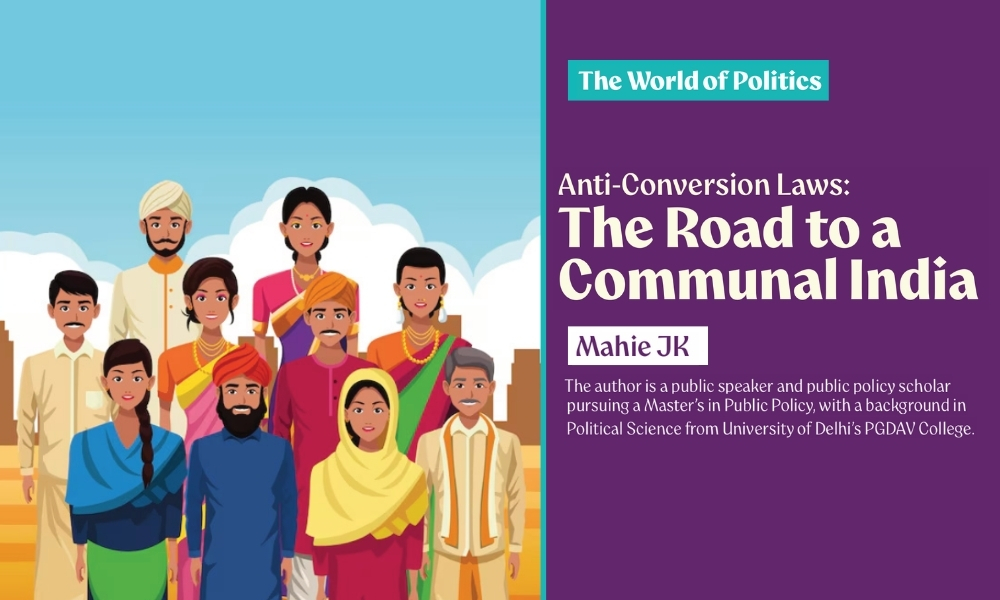
The author is a public speaker and public policy scholar pursuing a Master’s in Public Policy, with a background in Political Science from University of Delhi’s PGDAV College.
Religion and Secularism in India
Religion has always been positioned close to the hearts of Indian citizens throughout history. Our Constitution, under the 42nd Amendment, calls India secular, where every religion is respected.
Under Articles 25–28, the right to freedom of religion in India allows one to profess any religion or convert into any faith, and to profess and practice any belief.
Across history, religion has been the heart and soul of India’s culture, traditions, beliefs, rituals, and festivals. With its vibrant culture and traditions, all religions of various communities are followed religiously in India.
India has been ruled by Hindu, Muslim, and British rulers, and the elements of all these vibrant communities are enshrined in India’s culture.
Mahatma Gandhi, the Father of the Nation, used to propagate the idea that religion is a personal matter and personal faith should not be mixed with politics. But is that the real scenario? A deep question arises about religion mixing with politics.
Today, India’s case of religion mixed with politics is often used by politicians to gain votes from voters.
India is home to all religions. It is a womb where all faiths, cultures, and religions are safely protected. But the revealing fact is that India is losing its role as a womb for various faiths because of authoritative or communal politicians whose strategy is aimed at making India communal.
Our framers of the Constitution – Ambedkar, Nehru, and even Gandhi – envisioned India as secular. But the disheartening truth is that their vision is becoming blurred, with little hope for secularism until India is ruled by communal politicians.
Religion and Politics
Various strategies have been used by the government in recent times that break the heart of the secular soul. A law on citizenship made by the government is viewed as discriminatory. Muslims and Christians are denied citizenship in India – another road to communal India created by politicians.
India was envisioned as a secular country, but many critics argue that recent political developments are pushing the country towards majoritarian politics.
Ambedkar, the Father of the Constitution, took the road of conversion from Hinduism to Buddhism because of the oppressive caste-based system. He advocated dignity and equality for Dalits through conversion.
Anti-Conversion Laws and Concerns
Recently, anti-conversion laws have been passed by the State governments of Maharashtra and Chhattisgarh, where the government stated that the laws were passed to prevent conversions based on fraud, force, greed, or threat.
Citizens who want to convert have to file an affidavit 60 days in advance and publicly disclose their conversion before the court, along with the reason for conversion. Any illegal conversion will lead to punishment.
The government stated that people are not knowledgeable enough to understand the reason behind their conversion and therefore need the guidance of the government before conversion. The law is transparently seen as communal and as violating the right to freedom of religion. If a citizen willingly wants to convert his or her religion, they must seek the guidance of the government before conversion, as stated by the new law.
These laws are making India communal or Hindu-oriented by violating the right to freedom of religion and creating fear among other communities.
DID YOU KNOW?
Religious Freedom in India
Did You Know?
Article 25 of the Constitution of India guarantees freedom of conscience and the right to freely profess, practice, and propagate religion.
Did You Know?
Article 26 allows religious groups to manage their own religious affairs and institutions, subject to public order and morality.
Did You Know?
The Indian Constitution protects both individual religious freedom and the rights of religious minorities to establish and administer educational institutions under Article 30.
Good article by the author