

Marie Curie, born Maria Skłodowska on November 7, 1867, in Warsaw, Poland, is celebrated for her significant scientific contributions, unwavering spirit, and dedication to advancing knowledge. As the first woman to win a Nobel Prize and the only person to receive Nobel Prizes in two different scientific fields—physics and chemistry—Curie’s impact continues to shape cancer treatment and medical research today.
Despite the societal limitations on women’s education at the time, she pursued her academic dreams with determination. In 1891, she moved to Paris to study at the University of Paris (Sorbonne), earning degrees in physics and mathematics. This transition was challenging; she faced financial and cultural barriers, but her resolve never wavered. While in Paris, Curie immersed herself in physics and chemistry, developing a keen interest in radioactive materials. Her research led her to collaborate with physicist Henri Becquerel, who had discovered the phenomenon of radioactivity. This partnership paved the way for her groundbreaking discoveries.

In 1898, Curie and her husband, Pierre Curie, discovered two new radioactive elements: polonium and radium. This work was pivotal, enhancing the understanding of radioactivity and opening new therapeutic avenues for medical treatment. The Curies worked tirelessly to isolate radium from uranium ore, a complex process requiring advanced scientific techniques. Their discoveries were revolutionary. In an era when options for cancer treatment were limited, Curie’s research offered hope for more effective therapies. The Curies published their findings, detailing the properties of these elements, and the medical community began to take notice. While their work was met with enthusiasm and scepticism, Curie’s steadfast commitment to scientific inquiry helped validate their contributions.
Marie Curie recognised the potential of radium in treating cancerous tumours. By the early 1900s, she began experimenting with the element to understand its effects on living tissues. Her hypothesis was simple yet profound: if radiation could kill harmful cells, it could be harnessed as a treatment for cancer.
In 1906, tragedy struck when Pierre Curie died in a street accident. Despite her grief, Marie continued her work, determined to honour her husband’s legacy. By 1910, she isolated radium in its pure form, allowing for its use in medical treatments. This marked a significant advancement in oncology, providing a viable method for targeting and destroying malignant cells.
Her experiments demonstrated that radium could eliminate cancer cells, leading to its application in clinical settings. By the time World War I began, the medical community was starting to embrace the idea of using radioactive materials as therapeutic agents. This shift was crucial, as many cancer patients at the time faced grim prognoses with limited treatment options.
Curie’s pioneering work led to the first clinical applications of radium in treating cancer. In the early 20th century, doctors began using radium to shrink tumours, especially in skin cancer and other localised cases. The results were promising; patients often experienced significant relief from symptoms, and some even achieved remission.
However, Curie’s work was not without its challenges. The dangers of radiation exposure were not fully understood at the time. Many researchers, including Curie herself, suffered health issues due to prolonged exposure to radioactive materials. Curie developed aplastic anaemia, a condition that ultimately led to her death in 1934. Her experience highlighted the need for safety regulations in handling radioactive materials, which would become essential in modern medical practice.
Marie Curie’s contributions to cancer treatment were transformative, but her influence extended beyond her discoveries. She symbolises perseverance in science, especially for women in a male-dominated field. Curie’s achievements paved the way for future generations of female scientists, encouraging them to pursue careers in the sciences. Her tireless advocacy for applying her research in medicine also raised public awareness about cancer and its treatments. She worked to ensure that the potential of radium therapy was recognised, emphasising the importance of research in developing new strategies to combat the disease.
In the decades following her discoveries, radium therapy became a cornerstone of cancer treatment. Curie’s pioneering work laid the foundation for modern radiotherapy techniques—such as external beam radiation therapy and brachytherapy. Today, radiation therapy remains a critical component of cancer treatment, often used in conjunction with surgery and chemotherapy.
In recognition of her successes, Marie Curie founded the Curie Institutes in Paris and Warsaw, now world-class cancer research and treatment centres. These institutions have made important contributions to cancer research and the development of new medications, including targeted therapies and immunotherapy. The Curie Institutes have significantly contributed to cancer research by providing an environment that encourages creativity and collaboration among scientists and medical professionals. They also play a crucial role in training younger researchers and ensuring that Curie’s legacy is carried on in cancer. Research conducted at these institutes has led to significant advances in understanding cancer biology and developing new treatment methods. Scientists have built upon Curie’s findings, exploring various forms of radiation therapy and new strategies to minimise patients’ side effects.
Marie Curie’s contributions have been recognised worldwide. In addition to her Nobel Prizes, she received many accolades. In 1921, she was invited to the United States, where she received a gram of radium as a gift from the American government for her pioneering work. This event not only celebrated her achievements but also raised awareness about the potential of radiation therapy for cancer treatment.
Curie’s legacy is commemorated in various ways. Schools, research institutions, and scholarships have been named in her honour, reflecting her status as a scientific role model. In 1979, the International Atomic Energy Agency (IAEA) established the “Marie Curie Award” to recognise outstanding contributions to medical physics, further solidifying her impact on the field.
Her influence also extends to popular culture, where she has been portrayed in films, documentaries, and literature, highlighting her scientific achievements and struggles as a woman in science. This representation has helped raise awareness about gender equality in the scientific community, encouraging more women to pursue careers in STEM fields.
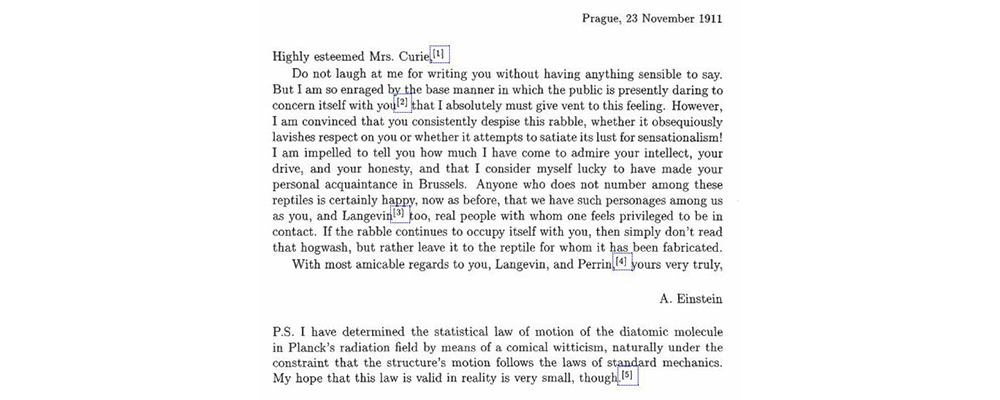
Albert Einstein, one of the most prominent physicists of the 20th century, acknowledged Curie’s contributions and the challenges she faced. In 1911, when Curie was under public scrutiny and personal difficulties, Einstein wrote her a letter offering support. He admired her work and character, stating, “You are a great woman, and your work is a beautiful chapter in the book of science.”
Picture Credit: Farnam Street
Einstein’s letter served as both encouragement and recognition, highlighting the respect Curie commanded in the scientific community. He appreciated her relentless pursuit of knowledge and her dedication to her research, especially when societal pressures on women in science were particularly intense. This correspondence reflects their mutual respect and underscores the importance of collaboration among scientists in advancing knowledge.
Despite her significant contributions, Curie’s personal life was challenging. As a woman in a male-dominated field, she faced scepticism and prejudice from some of her contemporaries. However, her intellect and dedication earned her the respect of her peers. Curie’s life was also marked by personal loss. The death of her husband, Pierre, was a profound blow. Nevertheless, she channelled her grief into her work, allowing it to motivate her further. Her ability to overcome adversity while maintaining her focus on scientific inquiry is a testament to her character.
Furthermore, Curie’s experiences during WWI underlined her commitment to using science for humanitarian purposes. She witnessed firsthand the effects of her research on soldiers injured during the war and applied her findings to improve medical care on the battlefield. Her innovative spirit and dedication to assisting others solidified her reputation as a scientist and applied science pioneer.
Marie Curie’s contributions to cancer treatment have had long-term implications for medicine. Her breakthrough radioactive research broadened scientific understanding and transformed cancer treatment. Despite enormous challenges, including personal tragedy and health risks, Curie’s determination and dedication to scientific discovery remained unshakable. Her legacy exemplifies the power of scientific inquiry and its ability to change lives. As we continue to push the boundaries of cancer research and treatment, Marie Curie’s foundations shine as a beacon of hope, reminding us of the importance of perseverance, innovation, and the pursuit of knowledge in the fight against cancer. Her story is one of triumph against adversity, proving that the pursuit of science is about the discoveries made and the individuals who work behind the scenes to improve the world.
Marie Curie’s journey from a little child in Poland to a world-renowned scientist shows the spirit of exploration and perseverance. Her life and work inspire scientists and patients alike, fostering a future in which innovation and compassion coexist.
References
Curie, Marie. Pierre Curie. 1923. (Autobiographical account)
Levinson, David. Marie Curie: A Biography. Greenwood Press, 2007.
Johnson, George. The Cancer Chronicles: Unlocking Medicinal Secrets of the Cancer Cell. Forthcoming.
“Marie Curie: Pioneer of Radioactivity.” NobelPrize.org, Nobel Media AB. [Link](https://www.nobelprize.org/prizes/physics/1903/marie-curie/facts/)
“Curie, Marie.” Encyclopædia Britannica, Encyclopædia Britannica, Inc. [Link](https://www.britannica.com/biography/Marie-Curie)
“Marie Curie: The Courage of Knowledge.” Directed by Marie Noëlle, 2016.
“The Radium Girls.” PBS American Experience, 2018.
“The Legacy of Marie Curie.” American Association for the Advancement of Science (AAAS). (https://www.aaas.org)
“Women in Science: Marie Curie.” National Women’s History Museum. [Link](https://www.womenshistory.org/education-resources/biographies/marie-curie)
Wambach, Christine. “The Role of Marie Curie in the Development of Radiotherapy.” Journal of Oncology, vol. 25, no. 3, 2015, pp. 123-130.
Einstein, Albert. Letter to Marie Curie, 1911. (Available in archives and various collections)
0 Comments