
The author is a social worker, educationist and writer.
قُلْ يَعِبَادِيَ الَّذِينَ أَسْرَفُوا عَلَى أَنفُسِهِمْ لَا تَقْنَطُوا مِن رَّحْمَةِ اللَّهِ
Say, “O My servants who have transgressed against themselves [by sinning], do not despair of the mercy of Allah.
The state of the world today—with wars, border tensions, genocides, corruption, poverty, hunger, systemic oppression, and environmental crises—can easily lead to despair, cynicism, and a loss of hope. Many believe that our era is uniquely plagued by suffering and that no time in history has faced as many challenges. But this perception isn’t entirely accurate. Every generation has struggled with its share of hardships. What makes today’s problems feel more overwhelming is not necessarily their scale, but their visibility—amplified by modern science, media, and technology. What we must seek from history is not just a record of crises, but a blueprint of resilience: how people endured, adapted, and progressed through dark times.
One of the most striking examples in human history is the period of Jahiliyyah—the Age of Ignorance—just before the advent of Prophet Muhammad (ﷺ). Arab society then was in turmoil: tribes constantly at war over petty disputes, entrenched in cycles of poverty and debt, with peace and hope nowhere in sight. It was into this moral and social darkness that the Prophet (ﷺ) emerged, bringing with him a transformative message grounded in faith, justice, and hope. One of his most remarkable qualities was his ability to inspire optimism—even in the bleakest of circumstances—reigniting a sense of purpose and direction in a people who had long abandoned both.
Soon, the world witnessed the rise of a new dawn—one filled with hope, energy, and purpose—which gave birth to a civilisation rooted in justice, compassion, peace, and prosperity. Among the many divinely guided strategies employed by the Prophet (ﷺ), perhaps the most powerful was his ability to instil hope in a society that had long abandoned it. And this hope was universal—offered to all, regardless of gender, social class, skin colour, or region.
Let us reflect on how the Prophet (ﷺ) nurtured hope among his companions and worked tirelessly for their upliftment—and the well-being of everyone around them. The positive outlook he cultivated was not limited to worldly success; it extended to the Hereafter as well, fostering a deep and enduring sense of purpose that transcended this life.
Hope for Dunya (the material world)

One of the most well-known incidents is the Treaty of Hudaibiyyah. Most of the companions saw it as a defeat, but the Prophet (ﷺ) assured them it would lead to a greater triumph. Within two years, they were able to take over Makkah without any bloodshed.
While the companions were frantically digging a 5.5 km trench on the northern border of Madinah to protect the city from an army far stronger in every way, Prophet Muhammad (ﷺ) promised them the keys to the superpowers of the time. He didn’t let fear, hunger, or the gravity of the situation make them lose hope. Through his inspiring words, he helped them shift from a victim mindset to that of changemakers who strive to improve their situation, no matter how small their efforts. The following Hadith illustrates the incident:
An-Nasaa’i and others have reported that when the Companions were digging Al-Khandaq (the trench), they found a rock too immense for their spades to break. So, they sought the help of the Prophet (ﷺ). He struck the rock three times, and each time a bright light sparked—another narration says it was like a light in the night. This proves three sparks came with each strike. He took the spade and struck the rock, uttering:
“Allaahu Akbar (i.e. Allah is the Greatest)! The keys of ancient Syria are granted to me, I swear by Allah, I can see its palaces at this moment.”
On the second strike he said:
“Allaahu Akbar, Persia is granted to me, I swear by Allah, I can now see the white palace of Madain.”
On the third strike he said:
“Allaahu Akbar, I have been given the keys of Yemen, I swear by Allah, I can see the gates of Sana’a while I am in my place.”
(Ahmad)
During Hijrah, while hiding in the cave from the Quraish who were searching for them, the Prophet (ﷺ) consoled his companion Abu Bakr (RA) with these words from the Qur’an:
“…and he was but one of the two when they were in the cave, and when he said to his companion: ‘Do not grieve. Allah is with us.’”
(Qur’an 9:40)
Imagine—he said this when the enemies were right above them, and there was every chance they could be discovered.
Another astonishing moment of hope occurred when Suraqa was about to catch the Prophet (ﷺ) and his companion during the Hijrah:
The Prophet (ﷺ) gave him a written promise of protection from any future violence and said to Suraqa ibn Malik:
“What about a day when you will be wearing the Bracelets of Kisra?”
There was only one Kisra, and everyone knew who that was. Suraqa was so shocked he had to clarify:
“Kisra!?”
The Prophet (ﷺ) said:
“Yes, Kisra, the son of Hormuz.”
This promise was made at a time when the Prophet (ﷺ) and his companions were fleeing Makkah, leaving everything behind, with seemingly no secure future ahead.
The Prophet (ﷺ) once said:
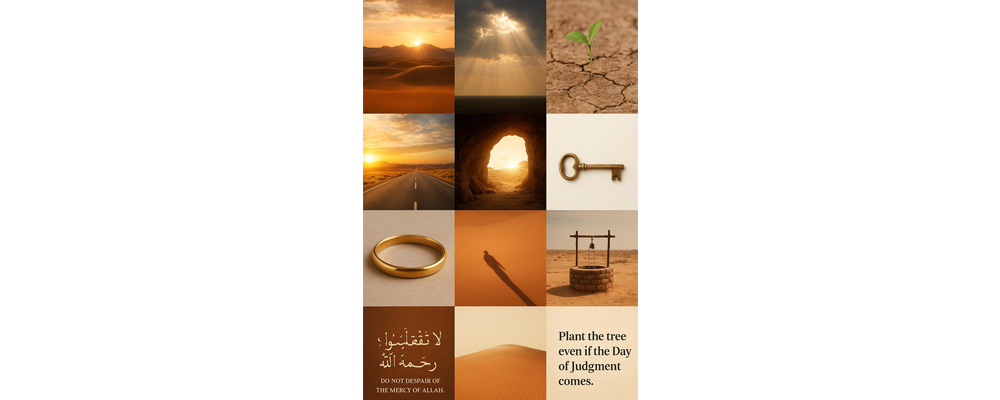
“If the Day of Judgement erupts while you are planting a new tree, carry on and plant it.”
(Musnad Ahmad, 12902)
This powerful image of hope teaches that even in the face of inevitable doom, human effort still holds value. It shows that no positive action is ever wasted, and that believers are never permitted to surrender to despair.
Hope for Aakhirah – the eternal world after death

The image the Prophet (ﷺ) cultivated of Allah was that of a Merciful, Compassionate Creator—near to every believer. Unlike other spiritual leaders who posed as intermediaries, the Prophet (ﷺ) brought people closer to Allah and taught them to ask directly, without any mediator. He gave hope to the hopeless—especially those rejected by society: the poor, slaves, women, and orphans. His teachings broke the chains of fatalism and despair. He reminded them that Allah’s mercy is greater than any sin, and that their future could be brighter than their past.
No matter how sinful a person may have been, the door to repentance was always open. This hope in Allah’s readiness to forgive made the Prophet’s (ﷺ) message deeply compelling. It’s one of the reasons why people accepted Islam so readily. A few examples from his sayings illustrate this well:
“Every son of Adam sins, and the best of the sinners are those who repent.”
(Sunan al-Tirmidhi, 2499)
This simple yet profound teaching restored dignity and self-worth to many, showing that worth lies not in perfection but in the willingness to turn back and change.
One of the most powerful stories is that of Wahshi ibn Harb, the man who killed the Prophet’s beloved uncle Hamza (RA). Years later, Wahshi accepted Islam but feared his crime made him unworthy of forgiveness. The Prophet (ﷺ) reminded him of the verse:
“Say, ‘O My servants who have transgressed against themselves [by sinning], do not despair of the mercy of Allah. Indeed, Allah forgives all sins.’”
(Qur’an 39:53)
By extending forgiveness to even his enemies, the Prophet (ﷺ) proved that no one is beyond redemption.
In another narration, the Prophet (ﷺ) said:
“Allah is more merciful to His servant than a mother is to her child.”
(Sahih al-Bukhari, 5999)
This comparison to maternal love—a universal symbol of unconditional care—reminds us that the Creator’s mercy is always within reach, especially in moments of weakness.
Consider this Hadith, which shows that there are many ways to earn Allah’s pleasure and that no one should feel hopeless:
On the authority of Abu Dharr (RA):
“Some people from amongst the Companions of the Messenger of Allah (ﷺ) said:
‘O Messenger of Allah, the affluent have made off with the rewards; they pray as we pray, they fast as we fast, and they give [much] in charity from their surplus wealth.’
He (ﷺ) said:
‘Has not Allah made things for you to give in charity? Truly every tasbeeh [saying: “SubhanAllah”] is a charity, and every takbeer [saying: “Allahu Akbar”] is a charity, and every tahmeed [saying: “Alhamdulillah”] is a charity, and every tahleel [saying: “Laa ilaha illa Allah”] is a charity. Commanding good is a charity, forbidding evil is a charity, and even in the sexual act of each one of you, there is a charity.’
They said, ‘O Messenger of Allah, when one of us fulfils his carnal desire will he have a reward for that?’
He (ﷺ) said, ‘Do you not see that if he were to act upon it in an unlawful manner, he would be punished? Likewise, if he acts upon it lawfully, he will be rewarded.’”
Conclusion

The very essence of Islam, as taught by the Prophet (ﷺ), is a hope-filled belief in a better life after death—a world of justice, peace, and eternal bliss. This hope motivates believers to remain upright, make sacrifices, and strive for betterment—not only of their own lives but of those around them.
In contrast, fear and confusion born from a lack of faith and hope in the Creator’s mercy lead people to silence in the face of oppression, to despair over small difficulties, and to give up on changing their lives for the better.
In short, the greatest gift the Prophet (ﷺ) gave to humanity was a renewed sense of purpose, dignity, and optimism. He instilled hope in the human spirit. He taught people to believe in their capacity to change, to do good, and to seek eternal reward. His message of hope spread far beyond Makkah and Madinah, transforming individuals and societies across continents. Through his life, he left a legacy of hope that continues to light the way even today.

0 Comments