
The author is an educationist and social worker from Mangalore
Introduction
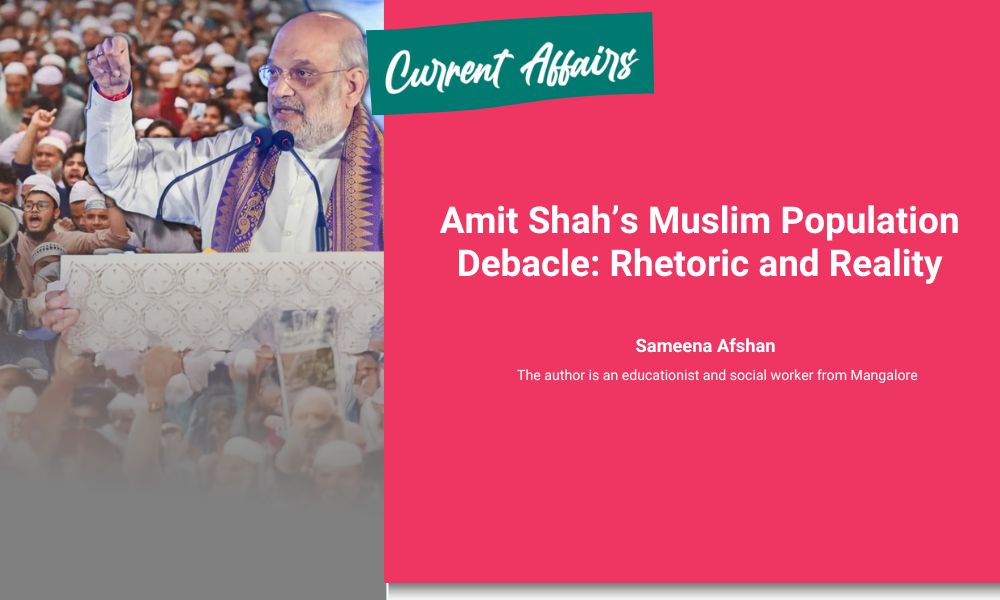
The Union Home Minister’s recent remarks on the Muslim population have ignited yet another heated debate. In a nation like India, where demographics have long been a subject of political discourse, these kinds of statements are not new. However, this time the tone has shifted. Now Amit Shah has attributed the rise in India’s Muslim population not primarily to natural fertility rates but to “large-scale infiltration” from neighbouring countries like Pakistan and Bangladesh. This new move contradicts the right-wing ecosystem’s age-old narrative that Muslims are a threat because they produce more children with the intent of outnumbering the majority population.
Facing the facts
If public memory is rewound to 1947, when British India was partitioned into India and Pakistan, it triggered one of the largest mass migrations in history. An estimated 14 to 18 million people were displaced, leading to a significant decline in the Muslim population share in India immediately after independence.
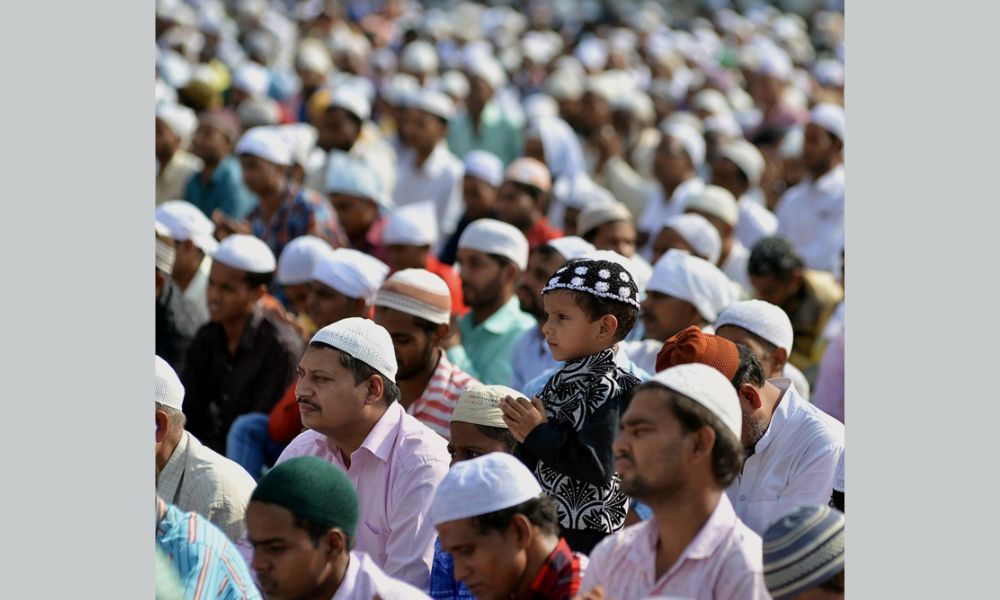
According to decadal census data, the most reliable source for tracking religious composition in India, the Muslim share of the population rose by approximately 4.4% between 1951 and 2011. This gradual increase is a natural demographic trend, largely driven by higher fertility rates, lower child mortality, and the avoidance of practices like female foeticide, which are often influenced by deep-rooted gender bias and a societal preference for male children. Studies by Pew Research and independent demographers confirm that India’s religious composition has remained broadly stable over the decades. Differences in population growth among religious groups are primarily attributed to fertility variations, which have been narrowing over time. There is no credible census evidence to suggest any sudden or deliberate demographic “takeover.”
In a most recent development, the concern about the rising Muslim population was reiterated by the right-wing’s supreme leader, who dramatically advised the families to at least have three children to avoid the threat of extinction. While this age-old tactic of fearmongering is in full swing now, the home minister has diverged and stirred another intimidation, saying it is not driven by fertility but by “infiltration”. The Prime Minister had already given a kick start to this narrative in his Independence Day address when he spoke about infiltrators and deliberately referred to a community, saying “the ones who have more children”.
Disturbing public discourse
The Home Minister’s remarks are problematic in many ways: Firstly, illegal migration is a law-and-order issue that must be addressed with proper evidence and due process. When there is a security lapse at the borders, it is a clear indication of policy failure and governance shortfall. It is to be recalled that India suffered a great loss of life due to such kinds of security lapses in Pulwama. Pahelgam etc. Meanwhile, the demographic changes are multi-causal social phenomena influenced by education, urbanisation, women’s labour force participation and access to health care. Conflating the two will result in treating families and settled communities as security risks rather than as citizens or residents with human rights.
Second, the claim of this large-scale infiltration has not been substantiated with public evidence that matches the scale of the alarmist language. Democracies need transparent data when they propose measures that will strip people of documents or citizenship. If the government has reliable proof of systemic cross-border demographic replacement, they should publish it and let courts and legislatures judge instead of using tactics to stoke fear.
Thirdly, this rhetoric has social consequences. When national leaders suggest that a religious minority’s presence is the product of foreign “infiltration,” they make it easier for ordinary citizens, bureaucrats and local politicians to treat that minority as lesser. That is not an unrealistic worry. Political rivals will exploit this narrative for electoral gains; exploitation will be legitimised, and everyday distrust between neighbours will rise.
Conclusion
While the concern about national security is important and a nation must certainly be vigilant about illegal entry at its borders, this vigilance must be matched by methods of data production, verification, and non-discriminatory processes. What the Union Home Minister declared is an inflammatory and factually dubious statement, rather a mere slogan: “detect, delete and deport”, that sounds like a proclamation of exclusion rather than a plan for careful governance. As he ended his speech, the Home Minister posed a question: “How will they get a place in the voter list?”. That is the exact motive behind these dubious claims. It is a systematic conspiracy to exclude Muslim voters from the voter list by easily stamping them as infiltrators, a dangerous vote bank politics disguised as demographic concern. That is why his comments demand not only a rebuttal on factual grounds but also a deeper reflection on the ethics of public argument in a multi-religious democracy.
Amit Shah’s remarks constitute a debacle not because demographic concerns are invalid but because they conflate facts with fear to serve political ends. Substantiated data shows that Muslim growth is driven more by internal factors than external invasions, yet framing it as a “threat” perpetuates a narrative that Muslims are outsiders, eroding trust in a pluralistic society. This isn’t politically incorrect; it’s politically irresponsible, especially from the Home Minister, whose role demands evidence-based governance over divisive politics. India’s strength lies in its diversity, but repeated episodes alienate minorities and distract citizens from pressing issues like economic inequality and border management. True concern would involve transparent census updates (delayed since 2021), better national security mechanisms, and efficient border policies, not vote-bank accusations.
Shah’s speech highlights a broader trend in Indian politics, using population as a proxy for cultural anxiety. These remarks will not be the last political attempt to turn demography into a wedge. But democracy has tools to resist it. It is essential to ground the conversation in history, statistics, and voices from across the spectrum. Facts, debate, accountability, and the rule of law should step in. Otherwise, these numbers will stop being neutral measures and become instruments of exclusion and a pretext for persecution.
0 Comments