
The author is a doctoral student at the University of Bristol and a published poet
I was eight years old when my persistent nagging had finally resulted in my mother and me at the counter of an electronics store, browsing the colourful display of hair implements. I stood, buzzing with excitement as she allowed my sister and me to pick the much-coveted flat iron. It was a large monstrosity of an object, nothing like the sleek hair straighteners on the market today; it was longer than my forearm, and just as thick. I had been blessed, like many South Indian girls, with a head of thick, black, rowdy curls. I had been small for my age, thin enough that my waist-length hair looked bigger than I did brushed out. At eight years old, I couldn’t wait to be rid of it.
When every on-screen makeover featured a bespectacled person with unruly curls going in, and coming out with sleek, pin-straight hair, it sends a message. Movies, television, magazines and advertisements alike reinforced this idea. Of course, it is not a well-kept secret that Eurocentric standards of beauty permeate our daily interactions with the world. Be it the colour of your skin, the shape of your nose, the thickness of your eyebrows, the slant of your eyes, and yes, the texture of your hair, what is considered attractive and desirable is informed by its proximity to whiteness. I have spent far too much of my life convincing people, myself included, to take pride in their ethnic features, rather than falling prey to the inherently racist standards of beauty.
Of course, it is easy to dismiss these concerns as ramblings born out of insecurity. Certainly, the mental health and self-confidence of our youth are important crusades, but it would be naïve to assume that beauty standards are only ever about beauty. No, desirability is not just meant in a romantic sense, but in a social sense. Fitting into the conventions of beauty gives you social desirability. Studies over the years in the fields of psychology and sociology have proven that, despite how much people may deny it, judgments happen instantaneously. Your appearance is how the world perceives you, your intelligence, your competence, your professionalism, etc.
In statistics, regression to the mean is a phenomenon that states that unusually high or low measurements tend to move closer to the average in subsequent measurements. This is often also true in other aspects of life, too. In an all roads lead to Rome type fashion, usually, everything falls back into the social norm. What the social norm is, of course, changes with time and place. However, with the global village that the world has become, especially with the popularisation of social media, the Global North becomes the norm. English is the most widely spoken non-native language for people worldwide. The brands we see as luxuries, the films we think of as classics, become driven by Western influence. The fact that Eurocentric features are the social norm of beauty is visible in the following two instances.
The Body Positivity movement has roots in a movement from the sixties started by black men and women in New York, who fought for the better treatment of fat people across different walks of life. This movement, rooted in equality and civil rights, over the decades, made it onto Instagram. Today, a quick image search of the words ‘body positivity’ or ‘body positivity influencer’ yields mostly white women. The Natural Hair movement was, too, rooted in black liberation and the fight for civil rights. Wearing your natural hair, rather than chemically relaxing it, or wearing straight wigs, became a symbol of resistance.
The CROWN Act was passed only in 2018, revised in 2022, tackling discrimination based on natural hair, preventing employers and educational
institutions from applying a dress code that did not accommodate natural hair. However, with the popularisation of the movement in the 21st century came the Curly Girl Method, which codified the methods of styling that were used by black people for centuries, and are now credited to a white woman. Similarly, on social media, the Curly Girl Movement, initiated by black women, with the intention to destigmatise coils and curls, has rapidly been overtaken by white content creators with wavy or curly hair. Obviously, in both these instances, the white women, too, are affected, perhaps to a different degree or in a different way by the issue at hand. However, it is crucial to notice patterns, as it seems like when a movement started by people of colour gains traction and becomes mainstream, it gets co-opted into what the social norm for visibility is. In a capitalistic society, when a movement becomes popular, it becomes profitable; to maximise profitability, you must maximise palatability.
“Beauty standards are not a matter of beauty at all, really; they are a matter of control.” Take, for example, chikankari work in India. Until chikankari was not replicable by machine, it was considered a luxurious item. It was hailed for its beauty and complexity. Today, chikankari can be accomplished by machine, and therefore, has become affordable and accessible across India. Now, chikankari often gets called cheap and unflattering, and is referred to as chapri, a derogatory term with casteist origins. Casteism and classism in India are deeply linked, inextricable from one another. Beauty standards control social acceptability. When the British went to Vietnam, they had songs and jingles for children talking about how short hair was better, moving away from their cultural practices and towards British cultural practices, which they believed to be superior. In ancient India, and even today, the way you wore your hair could indicate your caste and religion. From the shaved head with a preserved tuft of hair at the top of your head, beards, head coverings like hijabs, ghunghats, and turbans are indicators of caste and religion. The matter of who was allowed to cover their hair and who was not was, too, a matter of political interest. In ancient Arabia, whether women would cover their heads was dependent on tribe and class. In the antebellum South, intricate braid patterns of the enslaved women were seen as a threat. Head coverings, culturally and legally, became a way to enforce a dress code upon women to hide their hair. When this enforced dress code was then taken by the black women and turned into a fashion statement, it was yet again a cause for uproar.
When I was about twenty years old, I travelled on my own to visit my sister. It was an arduous journey, from my little idyllic coastal hometown to where my sister lived in the American South, hopping from one airport to another. One of the airports I had a layover in was Amsterdam Airport. I spoke English fluently, and had an Indian passport, yet, without engaging with anything I was saying, the authorities took one look at my hijab and asked if I needed an Arabic translator.
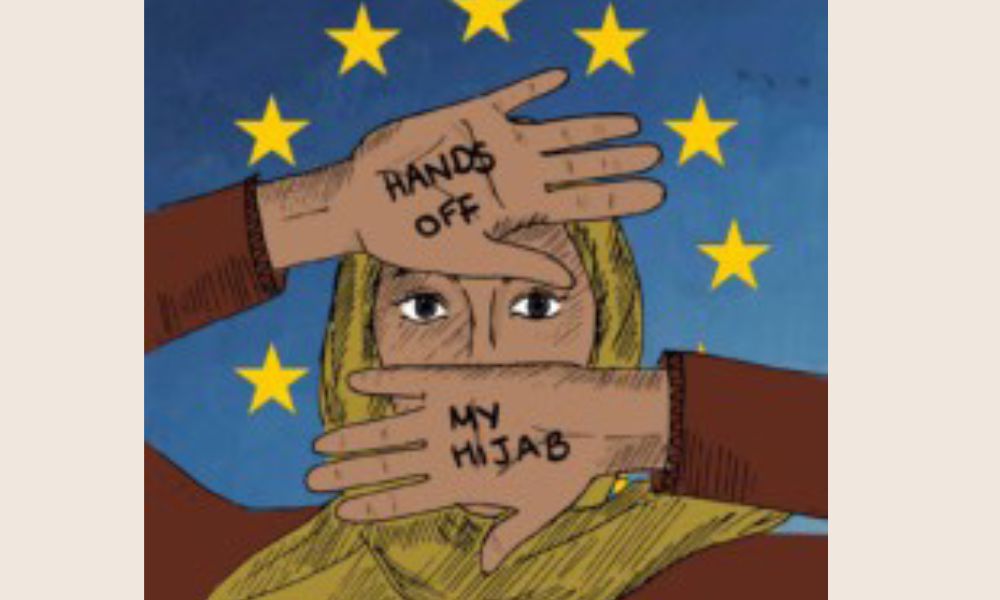
When my mother came to help me settle into my new home in the UK, while people spoke to me perfectly normally, they would see her in her black abaya and hijab get up and address me instead of her, expecting me to translate. My mother, who had been reading Shakespeare longer than I’d been alive, took it in stride. When your difference in the world is constantly visible, the colour of your skin, your facial features, your hair, your clothes, over time, you get used to the constant misconceptions people have of you.
We are all guilty of it. How often do you or your loved ones greet someone after summer vacations with, “You have gotten so dark?” Who are the celebrities we idolise and what do they look like? What kinds of clothes do we see as professional? This deep-rooted colonial and casteist mentality drives so much of our media that we get blind to it over time. I believe the role of education in our society is to remind us to stop taking things as they are. Pose questions constantly. The status quo is the status quo for a reason, and that reason may not be something you agree with.
I would like to pose a challenge to my readers. Close your eyes and picture what you see as beautiful: a celebrity, a person you know, a random composite of features you find beautiful. How much does that influence who you see as intelligent or competent, or worthy of leadership? Now consider what they look like, their features, and how much they fit into the conventions of beauty. Now consider where these specific standards stem from. How much of your idea of beauty stems from racist norms?
These patterns are not really about hair itself, or about beauty or acceptability; what is truly about is autonomy. Autonomy grants people power over themselves. Exercise this autonomy. Put it into practice. Refuse, first, to allow the colonial standards to make you question yourself or feel inferior, subsequently refusing the alterations it requires for you to fit in. If your body is your own, your mind is your own, and a public that is free in thought is the greatest threat to any oppressive power structure.

Very well written, Best wishes.