
The authors are are 3rd Semester students from University College of Law, Osmania University, Hyderabad. Having represented in several moot-court competitions, they share keen interests in researching and writing about contemporary concerns.
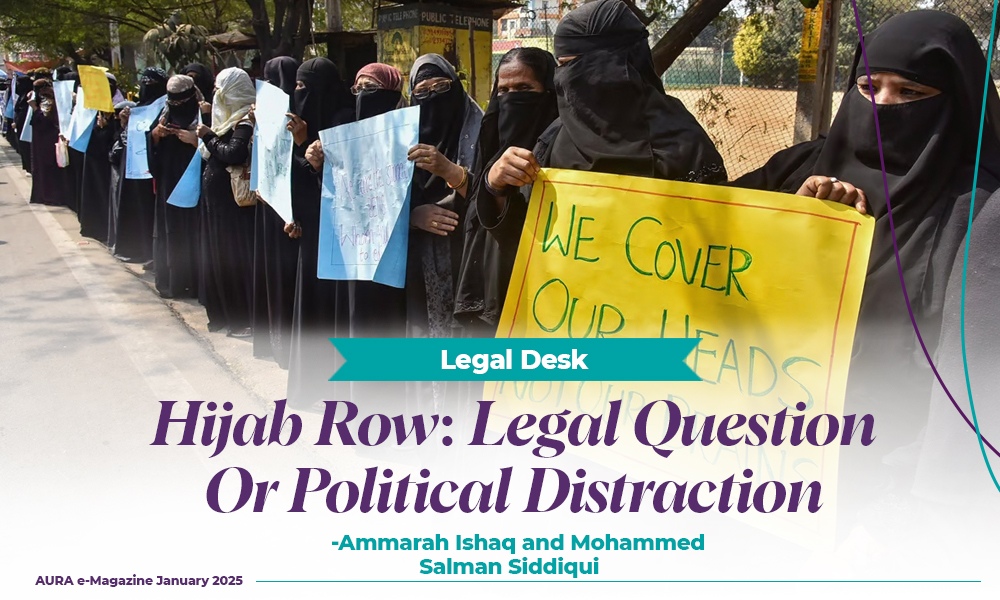
The recent and highly contentious ban on hijabs in educational institutions has sparked intense legal debates across India, challenging long-standing practices that have been integral to the identity of many students, in the case of Zainab Abdul Qayyum Choudhary and Ors. vs Chembur Trombay Education Societys and Ors, which has now escalated to the Supreme Court. The petitioners, who are law-abiding students, contend that the ban infringes upon their fundamental right to religious expression as enshrined under Article 25 of the Constitution. They argue that wearing the Hijab alongside their school uniforms does not disrupt public order or impede the educational process but instead serves as a critical expression of their faith. The Bombay High Court dismissed their claims, ruling that the Hijab does not constitute an essential religious practice within Islam, thereby excluding it from constitutional protection. This ruling, now under scrutiny by the Supreme Court, has issued a stay order on an instruction by a Mumbai private college that prohibited students from wearing the Hijab, caps, or badges on campus. The case has been scheduled for further hearings in November, with the bench allowing the college to seek modification of the order if necessary.
Judicial Authority vs. Individual
Autonomy: A Contested Jurisprudence
The Bombay High Court’s ruling, which upheld the ban on the hijab in educational institutions by invoking the “essentiality test,” raises a critical question: Is it within the judiciary’s purview to delineate what constitutes an essential religious practice? Originally conceptualised to protect religious practices from state interference, this test has paradoxically evolved into a tool for judicial overreach, wherein courts have assumed the role of arbiters of religious orthodoxy. The judiciary’s intervention in determining the essentiality of the hijab to Islam not only encroaches upon religious autonomy but also strips individuals—particularly women—of their agency. The argument that the hijab has “something to do with culture but certainly not with religion” reflects a reductive approach that fails to acknowledge the nuanced and deeply personal nature of religious expression. By imposing a binary framework on an inherently complex and multifaceted issue, the court’s ruling undermines the essence of religious freedom as enshrined in Article 25 of the Indian Constitution.
The application of the essentiality test, as seen in the Karnataka High Court’s verdict, illustrates a troubling trend where courts, rather than safeguarding religious liberties, have begun to circumscribe them. The judiciary’s inconsistent application of this test—demonstrated by disparate rulings on issues like the instant right to keep a beard as essential practice, triple talaq and mosque land disputes—exposes the inherent arbitrariness of this doctrine. Such judicial intervention not only contravenes the constitutional guarantee of religious freedom but also disregards the individual’s right to personal choice. In the case of the hijab, the court’s focus on the essentiality test, at the expense of considering the agency and choice of Muslim women, reveals a paternalistic attitude that is antithetical to the principles of individual autonomy and religious pluralism. This approach not only restricts religious freedom but also perpetuates a culture where the state—and by extension, the judiciary—asserts undue authority over deeply personal and spiritual matters.
The Legitimacy of the Hijab in Public Institutions: Upholding Constitutional Rights
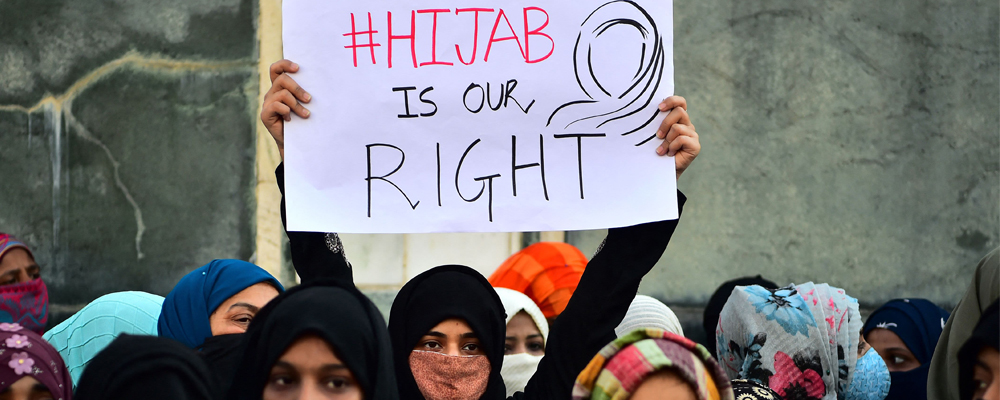
The struggle for quality education among Muslim women has historically been fraught with challenges, particularly within a socio-cultural milieu that often undervalues their right to education. Despite a gradual shift in mindset within the community, where education is increasingly embraced, the literacy rate among Muslim women remains alarmingly low, a reality further compounded by the pervasive societal barriers that impede their educational advancement. In this context, the hijab—far from being a mere cultural symbol—is an intrinsic part of a Muslim woman’s religious identity, deeply embedded in her spiritual and moral convictions. It serves as an outward expression of her faith and manifests her constitutionally guaranteed right to religious freedom under Articles 25 and 26 of the Indian Constitution. The denial of this right within public educational institutions not only infringes upon her religious liberties but also perpetuates the educational marginalisation of Muslim women, exacerbating the systemic inequalities they face.
0 Comments