
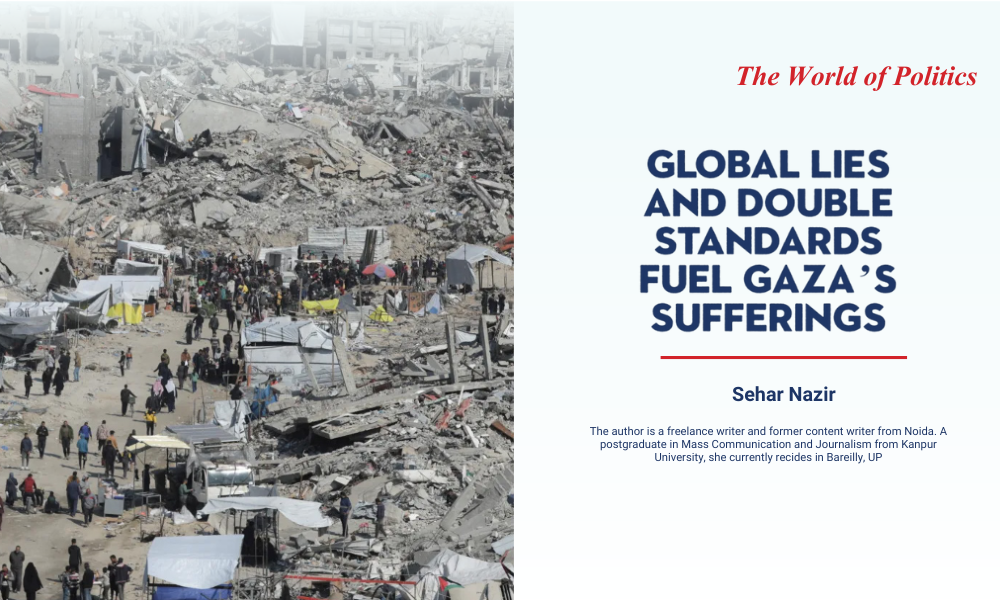
The author is a freelance writer and former content writer from Noida. A postgraduate in Mass Communication and Journalism from Kanpur University, she currently resides in Bareilly, UP
UN Hypocrisy: Gaza’s Wound, Our Test
Is This a Premeditated Act of Genocide or Ethnic Cleansing?
Humanitarian Crisis and Famine: The situation has reached catastrophic levels. More than half a million people in Gaza are trapped in famine, marked by widespread starvation, destitution and preventable deaths (CBS News). According to a formal declaration made on 22 August 2025 by major UN agencies—UNICEF, WHO and WFP—this situation has become a “catastrophe of epic proportions.”
UN officials warn that without immediate intervention and a ceasefire, the already dire conditions will only deteriorate further in the coming months. The time to act is now; lives are hanging in the balance, and we cannot turn a blind eye to this unfolding tragedy.
Gaza’s screams lay stripped of the UN’s double standards: speedy to condemn some, mute for others, it shields the powerful while the powerless die. This ethical decay shames every corner of the globe. Will we stand by as this hypocrisy deepens, or will we rise to demand justice for those crushed by the world’s disinterest?
“On this UN Day, it will be a day to speak up; we should not be silent. Gaza bleeds while the world recites. Peace without justice is not peace—it is Betrayal!”
Journalist Killings in Gaza: A Call for Accountability
“Easy to kill Truth—just eliminate Witness First.”
Since October 2023, Gaza’s journalistic environment has become one of the world’s deadliest, with at least 270 journalists killed amid escalating violence, according to Al Jazeera, Palestinian authorities, and press freedom organisations.
This crisis, marked by censorship and economic pressures, severely restricts independent reporting, obscuring the conflict’s realities. Israel denies deliberately targeting media workers, attributing casualties to operations against Hamas. However, international criticism has intensified, with human rights groups alleging failures to protect journalists and investigating possible war crimes.
The continuing toll not only threatens media workers but also undermines global efforts to document the conflict, threatening freedom of expression in one of the world’s most volatile regions.
The UN fails to provide media with safe zones for reporting, instead creating a deadly threat to press freedom!
As UN Day is approaching, celebrating the UN’s mission of peace, this tragedy exposes its double standard!
Test of Conscience for the Ummah: The Wound That Reveals Our Truth
The UN’s selective application of justice doesn’t merely harm Gaza—it strikes at the very dignity of the Muslim world. It exposes the hollow nature of “universal values” that bend to political convenience.
This institutional hypocrisy is not some distant diplomatic failure; it is an open wound on the body of the Ummah, demanding our urgent reflection and response.
When Ideals Fail the Test of Reality
As Muslims worldwide witness yet another UN Day pass, we confront a painful denial. The United Nations was founded on the promise of protecting the vulnerable and upholding justice for all. Yet Gaza—home to nearly two million of our brothers and sisters—stands as a testament to the betrayal of these very ideals.
How do we reconcile an organisation that speaks eloquently of human dignity while remaining paralysed in the face of our suffering? How do we trust in “universal” principles that seem to apply universally to everyone except us?
The Shame of Division
Fifty-seven Muslim nations and nearly two billion Muslims possess immense oil wealth and formidable military capabilities. Some have nuclear arsenals and space programmes. Yet, Palestinian children still dig through rubble with their bare hands to find their families.
How do we justify this to Allah and to history? Early Muslims defeated the world’s superpowers with faith and purpose. Now, we are divided and unable to protect a small territory, trapped by our wealth and politics of privilege.
The Architecture of Injustice
The UN’s veto system has become a tool of systematic denial—blocking justice for Palestinians while ensuring swift action for others deemed more politically valuable. This isn’t merely bureaucratic dysfunction; it’s a deliberate structure that institutionalises inequality and reduces Muslim lives to secondary concerns in the global order.
While some nations enjoy uncompromising international support and protection, the Muslim world watches as our pleas for justice are repeatedly silenced by the stroke of a pen, by the wielding of veto power that treats our pain as negotiable.
Western Islamophobia?
Isn’t this just Western Islamophobia? It’s too soon to conclude—let’s think critically.
This is not the first time. The Muslim world has long seen the UN’s double standards. From the failure to stop the genocide in Bosnia in the 1990s, to the inaction over the atrocities in Syria and Myanmar against the Rohingya, the message is clear: Muslim blood and Muslim lives are valued less. The so-called rules-based order does not apply to us.
These questions are tough, but they require our attention. This crisis challenges us to re-evaluate our values and commitment to a fairer, more accountable global system. By confronting these moral dilemmas, we can forge a path that honours the worth of every human life.
This is our moment of reckoning—a call to shape the world we desire with courage, compassion, and a steadfast pursuit of justice for all.
Hypocrisy flourishes when we choose apathy.
We all can make a difference—whether it’s through supporting reforms like veto limitations at the UN, advocating for humanitarian aid for Gaza’s civilians, or simply educating ourselves about these critical disparities.
As former UN Secretary-General Kofi Annan wisely noted:
“We may have different religions, different languages, and different coloured skin, but we all belong to one human race.”
Let this UN Day inspire us to break the cycle of inaction and awaken a global citizenry committed to moral responsibility and genuine justice.
The question we must confront is: When injustice whispers within the corridors of power, will you summon the courage to raise your voice?
“O you who believe, be steadfast in justice, witnesses for Allah, even if it be against yourselves.”
(Qur’an, 4:135)
A Voice that Dares to Speak: Mokhiber’s Conscience Call—A Beacon against UN Hypocrisy
Craig Mokhiber, a UN human rights lawyer with 32 years of experience, resigned in October 2023, denouncing the UN’s inaction on Gaza’s “genocide.”
He accuses the UN of yielding to US and UK pressure, neglecting the Palestinians while condemning other conflicts. Having worked in Gaza and Darfur, Mokhiber labels Israel’s actions as apartheid, a claim supported by some human rights groups but contested as biased.
In 2025, he advocates for justice, sanctions, and a single democratic state in Palestine, urging public protests and boycotts to address the UN’s failures.
“Justice must be universal, not selective.”
The Call to Conscience
The test before the Ummah is clear and urgent. We cannot remain inactive witnesses to this systematic injustice. Our response must be:
- Harmonious and Determined: Let every Muslim voice join the ensemble demanding accountability for these broken promises.
- Strategic and Sustained: Move beyond momentary anger to build lasting pressure for genuine reform.
- Principled and Persistent: Stand firm on our values even when international institutions abandon theirs.
The core message for everyone is to take meaningful action through protests, aid, and advocacy. By strengthening the specifics and clarity of the proposed responses, we can inspire more people to join the fight for justice and peace in Gaza. United, strategic, and principled, our collective voice can drive lasting change.
Our Sacred Duty
For those still trapped in Gaza’s darkness, for those still waiting for justice denied, we must become their voice when the world chooses silence. We must be their advocates when international bodies fail them. We must be their hope when systems designed to protect them instead abandon them.
The conscience of the Ummah is being put to the test. History will judge not only those who commit injustice, but those who witness it and choose silence over solidarity.
The time for reflection has passed. The time for action is now.
“Let us rise to meet this test, for the sake of Gaza, for the dignity of the Ummah, and for the sacred principle of justice that transcends all political calculations.”
We stand at a crucial moment that demands reflection on our global responsibilities and the essence of justice. We must face some uncomfortable truths:
- Are we prepared to accept a world order that devalues certain lives and ignores the equal dignity of all?
- Can we trust institutions that consistently fail to address serious injustices and alleviate suffering?
- How can we hope for justice when those tasked with protecting it overlook vulnerable communities?
0 Comments