

The author is a law student at the University of Mumbai
Education in the Muslim intellectual tradition has never been limited to classrooms, examinations, or degrees. From the earliest Islamic institutions to modern universities, education was imagined as a space of inquiry, debate, dissent, and moral responsibility. Universities were not merely sites of instruction; they were arenas where ideas were contested, and societies were shaped. This legacy stands in sharp contrast to contemporary realities, where educational spaces, particularly in institutions with significant Muslim student populations, are increasingly regulated, securitised, and politically constrained.
Historical Legacy: Education as Freedom and Agency
Institutions like Al-Qarawiyyin, Aligarh Muslim University, Jamia Millia Islamia, and Osmania University were built on the idea that education empowers individuals to think critically and act responsibly. Debate, disagreement, and collective participation were intrinsic to these spaces. Learning was inseparable from ethical engagement with society.
Figures such as Sir Syed Ahmad Khan and Maulana Abul Kalam Azad envisioned universities as nurseries of leadership and democratic consciousness. For them, education was a means to uplift communities, challenge injustice, and participate meaningfully in public life. Student engagement, both formal and informal, was seen as a vital component of intellectual growth.
Student Unions: The Democratic Soul of Campuses
Student union elections historically served as training grounds for democratic participation. They nurtured leadership, negotiation, accountability, and collective decision-making. Many of India’s prominent public figures emerged from student politics, learning the ethics of representation within campus spaces.
However, in recent years, student union elections have been suspended, delayed, or diluted across several universities. The official justification often cites administrative convenience, campus discipline, or security concerns. Yet, the consequence is the gradual erosion of students’ right to representation. When elected bodies are replaced by nominated committees or ad-hoc arrangements, the democratic character of the university is weakened.
For institutions with a strong legacy of political consciousness, particularly central universities and minority institutions, this restriction is especially significant. It disrupts a tradition where students were encouraged to question, debate, and participate in shaping institutional life.
Campus Securitisation and the Normalisation of Force
Another troubling development is the increasing presence of police and paramilitary forces on university campuses, especially during protests, elections, or periods of dissent. Educational spaces, once protected as zones of dialogue, are now frequently treated as potential sites of unrest.
The deployment of armed forces in response to student gatherings sends a powerful message: dissent is to be managed through surveillance and control rather than conversation. This approach fundamentally contradicts the spirit of education envisioned in the Muslim intellectual tradition, where disagreement was considered a pathway to truth, not a threat to order.
Notably, such securitisation is disproportionately visible in central universities and institutions with large Muslim student populations, reinforcing feelings of alienation and stigmatisation. This raises serious questions about equality, trust, and the right to peaceful expression.
Contesting Identity and Freedom within University Campuses
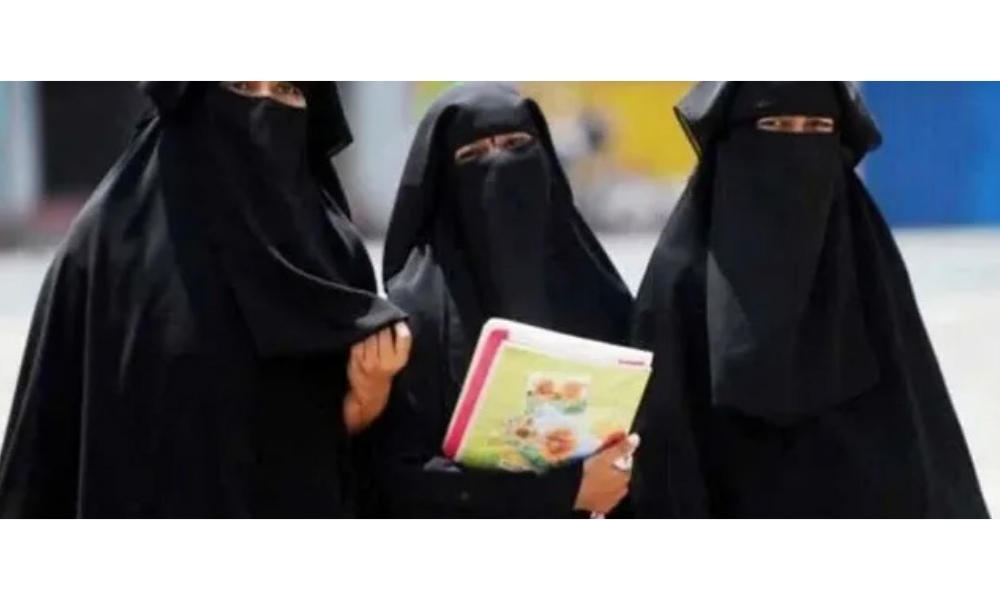
Issues of religious expression have also come under strain, with restrictions on burqa and hijab in certain colleges being justified under the guise of uniformity or discipline, effectively forcing Muslim women to choose between education and identity.
Incidents such as those reported at Ideal College, Kalyan, where students were allegedly penalised for offering Friday prayers and pressured to chant religious slogans, reflect a troubling intrusion of ideological coercion into academic life.
Similarly, hijab bans reported in colleges in areas like Goregaon demonstrate how exclusion is increasingly enacted through administrative regulations, undermining the pluralistic and secular ethos envisioned for educational institutions.
Together, these developments indicate a broader shift from universities as spaces of participation, dignity, and diversity toward institutions governed by control, conformity, and fear standing in contradiction to the historic Muslim educational legacy rooted in inquiry, freedom, and ethical responsibility.
From Knowledge Seeking to Compliance
The shift from participatory campuses to regulated and securitised spaces reflects a broader transformation in how education is understood today. Universities are increasingly framed as service providers producing employable individuals rather than critical citizens. In this framework, student activism is seen as disruption, and political engagement as indiscipline.
This marks a departure from Maulana Abul Kalam Azad’s legacy, who argued that education must produce socially conscious individuals capable of ethical reasoning and civic responsibility. Suppressing student voices undermines this vision and reduces education to technical training devoid of moral and democratic substance.
The Muslim Educational Legacy as Resistance
The Muslim legacy of education offers an important counternarrative to these developments. It reminds us that learning thrives in environments of openness, dialogue, and trust. Institutions like Aligarh, Jamia, and Osmania were not created to produce silent conformity but informed leadership.
Reviving this legacy today does not mean romanticising the past. It means defending campuses as democratic spaces where students can organise, elect representatives, express dissent, and engage with power structures without fear. It means recognising that student unions are not threats to education but extensions of it.
Conclusion: Reclaiming the University
The crisis facing contemporary universities is not merely administrative; it is philosophical. When elections are suspended, protests are criminalised, and campuses are militarised, education loses its emancipatory character.
The Muslim educational tradition, rooted in critical inquiry, ethical engagement, and social responsibility, calls for a reimagining of the university as a space of trust rather than control. Protecting student participation and democratic practices is not a concession; it is a reaffirmation of what education truly stands for.
In remembering Al-Qarawiyyin, Sir Syed, Jamia, Osmania, and Maulana Azad, we are not only recalling history, we are being asked to defend the future of education itself.
YOUR BRAIN USES MORE ENERGY
THAN YOU THINK.
0 Comments