
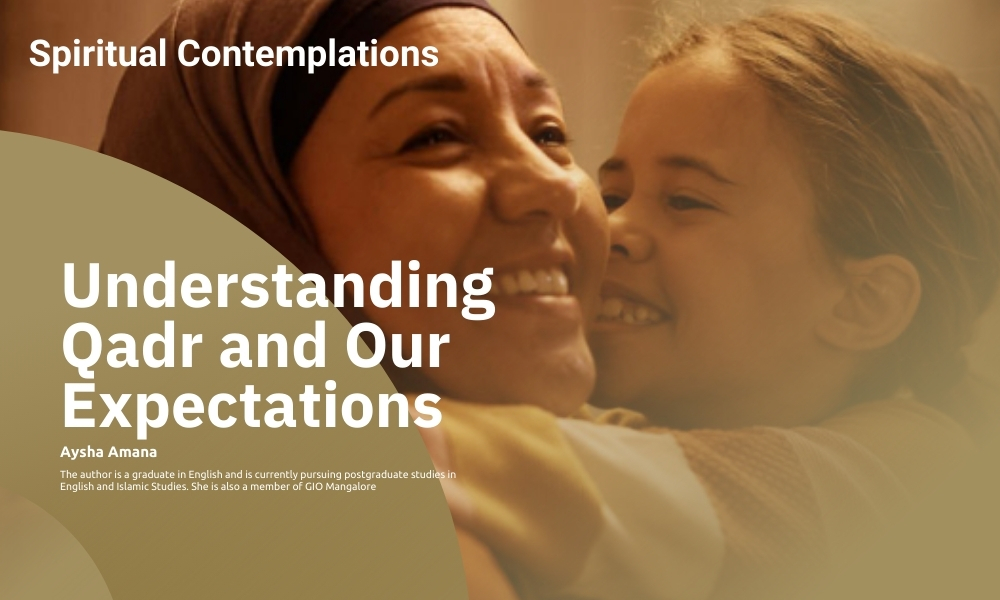
The author is a graduate in English and is currently pursuing postgraduate studies in English and Islamic Studies. She is also a member of GIO Mangalore
Understanding Qadr and Our Expectations
In Islam, there are six articles of faith, one of which is belief in Divine Decree (Qadr)—the belief that everything occurs by the will, wisdom, and knowledge of Allah. Yet in the modern world, this concept is often misunderstood. Many of us live with a pre-written script of how life should unfold—designed mainly to satisfy our personal desires and worldly ambitions. Over time, this mindset subtly shifts us from being akhirah-oriented to dunya-oriented, often without us realising it.
As attachment to the world grows, dissatisfaction grows alongside it. This is why we see people who appear to have everything—wealth, status, and comfort—yet live with inner misery, while others with very little experience peace and contentment. Islam does not condemn wealth or comfort. What it condemns are pride, arrogance, and attachment that distracts the heart from Allah. Islam remains a complete way of life, offering guidance for personal conduct, family life, social responsibility, and professional ethics.
Unrealistic Expectations and the Illusion of Control
Many disappointments in life stem from unrealistic expectations. We desire a specific kind of house, a brand-new car, an ideal spouse, perfect children, and a life that follows our imagined timeline. At a deeper level, we often expect to be rewarded in this world for our efforts, sacrifices, and good actions.
When these expectations are not met—when people fail us, plans collapse, or outcomes differ from what we hoped for—disappointment sets in. This happens because we forget a fundamental truth: this world is not the place of ultimate reward. It is a place of effort, patience, and trust, while true and complete reward is promised in the akhirah.
At the heart of this disappointment lies another forgotten reality—we are not the authors of our lives. Allah is. When we expect dunya to compensate us fully for our actions, we burden our hearts with expectations they were never meant to carry. But when expectations are redirected toward Allah and the akhirah, contentment gradually replaces frustration.
Life as a Test: Lessons from Surah
Al-Kahf
Surah Al-Kahf presents a powerful reminder of the nature of this world through four major trials faced by human beings:
- Faith (Ashab al-Kahf)
- Wealth (the man with two gardens)
- Knowledge (Musa عليه السلام and Khidr)
- Power (Dhul-Qarnayn)
Every individual and every nation is tested through these same means. Allah says:
“And We test you with evil and with good as a trial, and to Us you will be returned.”
(Surah Al-Anbiyā’ 21:35)
These trials are not signs of Allah’s displeasure, but opportunities to reveal the state of our hearts—whether we respond with gratitude and patience or with pride and complaint.
Trials of the Prophets: A Universal Reality
Even the Prophets of Allah were tested:
- Adam عليه السلام with obedience
- Nuh عليه السلام with rejection and prolonged struggle
- Ibrahim عليه السلام with a disbelieving father and lifelong sacrifices
- Yunus عليه السلام with hardship and isolation
- Yusuf عليه السلام with beauty, desire, and injustice
- Sulaiman عليه السلام with power and authority
Our beloved Prophet Muhammad ﷺ was tested with the loss of his parents and loved ones, intense opposition, and deep personal pain. Yet he responded with patience, mercy, and service—seeking reward from none other than Allah. His life teaches us that hardship is not a sign of failure, but often a means of drawing closer to Allah.
Balance Is the Sunnah
A well-known hadith highlights the Prophet’s balanced approach to worship and daily life. Anas ibn Malik رضي الله عنه narrated:
Three men came to the houses of the wives of the Prophet ﷺ asking about his worship. When they were informed, they considered it little and said, “Where are we compared to the Prophet ﷺ? Allah has forgiven his past and future sins.” One of them said, “I will pray all night.” Another said, “I will fast continuously and never break my fast.” The third said, “I will stay away from women and never marry.”
When the Prophet ﷺ heard this, he said:
“By Allah, I am the one who fears Allah the most among you and is the most conscious of Him; yet I fast and I break my fast, I pray and I sleep, and I marry women. Whoever turns away from my Sunnah is not from me.”
(Sahih al-Bukhari 5063 | Sahih Muslim 1401)
This hadith reminds us that balance is central to Islam. Extremes—whether in worship or in worldly indulgence—pull us away from the Prophetic path. Islam does not ask us to abandon the world, but to live within it responsibly, without allowing it to dominate our hearts.
This World Is a Testing Ground
This world is not a place of full compensation; it is a place of examination. Each person is tested through what they value most—wealth, relationships, success, or loss. Allah asks:
“Do people think that they will be left to say, ‘We believe,’ and they will not be tested?”
(Surah Al-‘Ankabut 29:2)
Despite material progress and widespread education, modern society often suffers from spiritual illiteracy. Allah’s first command was:
“Read in the name of your Lord who has created.”
And He clearly states:
“I did not create jinn and mankind except to worship Me.”
This reminds us that every aspect of life can become an act of worship when guided by sincerity and intention.
Living Islam Holistically
Unfortunately, Allah and His Book are often placed at the end of our priority lists. Studies, careers, finances, relationships, and social life take precedence. While these pursuits are not wrong, they require balance. Islam does not promote isolation or monasticism. The Prophet ﷺ encouraged seeking knowledge, building careers, marrying, raising families, and serving society—all within the boundaries set by Allah.
The Qur’an is not merely a book for recitation; it is a manual for living, guiding us in navigating the dunya to ensure success in the akhirah.
The Prophet ﷺ said:
“Actions are judged by intentions, and every person will be rewarded according to what he intended.”
In a world driven by appearances, sincerity is often overshadowed by performance. Good deeds are sometimes done for recognition rather than Allah, and morality becomes selective.
The Prophet ﷺ reminded us of this inner reality when he said:
“Indeed, Allah does not look at your bodies or your appearances, nor at your wealth, but He looks at your hearts and your deeds.”
(Sahih Muslim 2564)
This hadith re-centres our understanding of success and righteousness. What holds value in the sight of Allah is not outward image, social status, or material possession, but the condition of the heart and the sincerity behind our actions. Similarly, we may accept parts of the Qur’an that suit our preferences while avoiding those that challenge us. Yet Allah commands:
“O you who believe, enter into Islam completely (wholeheartedly).”
(Surah Al-Baqarah 2:208)
A Call to Action
If we wish to move from a dunya-oriented mindset to an akhirah-oriented one, the change must begin within us. Let us start small but consistent—by reconnecting with the Qur’an daily, resetting our intentions before our actions, and consciously releasing the expectation of worldly reward for every effort we make.
Let us ask ourselves not only, “What do I want from this world?” but, “What does Allah want from me at this moment?” When Allah becomes our goal, disappointment loses its grip. When the Qur’an becomes our guide, balance becomes possible.
May Allah make us among those who live by the Qur’an, embody its values, and reflect its light through our actions—people whose lives quietly point others toward the akhirah, even while living responsibly and purposefully in the dunya.
Allahumma baarik
Well written
Relevant. Crisp. To the point. Need of the hour.
Inspiring.. mashallah
Keep spreading beneficial knowledge
Masha Allah. Excellent article, enlightening approach.
Masha Allah,keep it up.
[7015]6sbet Official Login | অনলাইন স্লট গেম ও বিকাশ বোনাস,6sbet-এ লগইন করে সেরা অনলাইন স্লট গেম উপভোগ করুন। দ্রুত বিকাশ পেমেন্ট পদ্ধতি এবং আকর্ষণীয় বোনাস পেতে আজই অ্যাপটি ডাউনলোড করুন। visit: 6sbet