
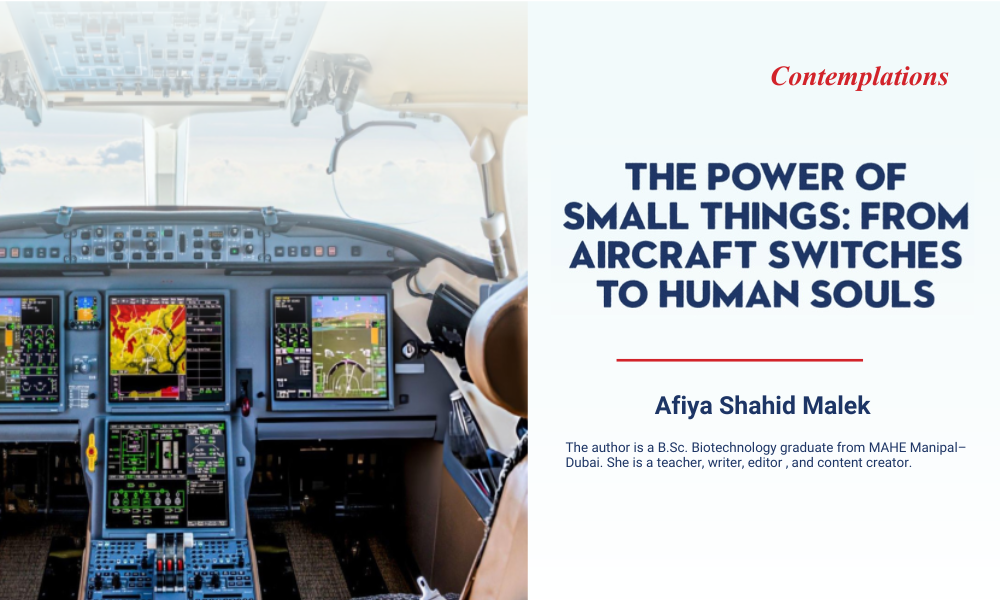
The author is a B.Sc. Biotechnology graduate from MAHE Manipal–Dubai. She is a teacher, writer, editor, and content creator.
The Anatomy of Catastrophe
The tragedy of Air India Flight 171 serves as a stark reminder that in the most sophisticated systems, the smallest components can determine life or death.
On 12 June 2025, a Boeing 787 Dreamliner carrying 242 passengers and crew crashed shortly after take-off from Ahmedabad. Investigators found that fuel control switches in the cockpit had been flipped, starving the engines of fuel. In mere seconds, two simple switches transformed a marvel of engineering into a catastrophe, claiming 241 lives and leaving only one survivor.
This devastating incident illuminates a profound truth that extends far beyond aviation: in complex systems, whether mechanical or biological, the smallest elements often hold the greatest power. The fuel switch that may have caused this tragedy was no larger than a household light switch, yet its position determined the fate of hundreds of souls and a $200 million aircraft.
Modern aircraft like the Boeing 787 represent the pinnacle of human engineering. These machines incorporate millions of components, from titanium engine blades spinning at 10,000 revolutions per minute to computer systems processing thousands of data points per second. Yet, as Flight 171 tragically demonstrated, all this complexity can be undone by the movement of a single switch.
The fuel control switches in question are designed with multiple safety protocols and warnings. They are not easily moved by accident, requiring deliberate action to change position. This makes their role in the crash even more haunting – whether through human error, mechanical malfunction, or intentional act, these tiny guardians of the fuel supply failed in their most critical moment.
This phenomenon extends throughout aviation history. The 1988 Aloha Airlines Flight 243 disaster began with a single faulty rivet among thousands. The 2009 Air France Flight 447 crash resulted from ice crystals blocking pitot tubes no larger than pencils. In each case, components representing a fraction of the aircraft’s total mass and cost brought down entire systems worth hundreds of millions of dollars.
The Human Parallel
The human body presents a remarkable parallel to these complex machines. Like an aircraft, we are intricate systems where every component, no matter how small, plays a vital role.
- A single blocked artery, narrower than a pencil, can cause a heart attack.
- A microscopic virus can bring down the strongest athlete.
- A small blood clot can trigger a stroke that changes a life forever.
Consider the human heart, weighing merely 300 grams, beating over 100,000 times daily, pumping life-sustaining blood through 60,000 miles of vessels. Yet its function depends on electrical impulses generated by the sinoatrial node – a structure smaller than a coin. When this tiny “switch” malfunctions, the entire system can fail.
The brain, our body’s flight control centre, relies on neurotransmitters – chemical messengers so small that billions fit in a single drop of water. Imbalances in these microscopic substances can lead to depression, anxiety, or other mental health conditions that affect every aspect of life.
The immune system shows this principle beautifully. White blood cells, invisible to the naked eye, patrol our bodies like security guards, identifying and eliminating threats. A single compromised cell can multiply into cancer, while a properly functioning immune system can prevent or fight off diseases that would otherwise be fatal.
The Soul’s Small Moments
Moving beyond the physical, we find the same principle in the realm of the human soul. Our relationship with Allah, like the aircraft’s relationship with its fuel supply, depends on seemingly small but crucial connections.
In Islam, great transformations often begin with small acts. A moment of sincere duʿā, a single act of charity, a word of forgiveness – these might seem insignificant, yet they can redirect entire destinies. Like the fuel switch that controls the aircraft’s power, these small spiritual choices determine whether our souls soar toward Jannah or crash in this world and the next.
The Islamic concept of ḥasanāt teaches that even the smallest good deed, done with pure intention (niyyah), can outweigh years of negligence. Prophet Muhammad ﷺ said:
“Do not belittle any good deed, even meeting your brother with a cheerful face.”
(Sahih Muslim)
These small spiritual components – intention, attention, devotion to Allah – are among the most powerful forces in shaping our eternal destiny.
Consider how:
- A single moment of tawbah (repentance) can transform a lifetime of mistakes.
- One act of authentic forgiveness can heal decades of resentment.
- A brief moment of connection with Allah through prayer or dhikr can provide strength for years of challenges.
These are the spiritual equivalents of the aircraft’s fuel switches – small controls that determine whether the soul’s journey ends in triumph or tragedy.
The Maintenance of Excellence
Both aircraft and human souls require constant maintenance and attention to detail. Airlines spend millions on preventive maintenance, knowing that neglecting small components can lead to catastrophic failure.
Similarly, our spiritual and physical well-being depends on daily attention to seemingly minor details.
Just as pilots perform pre-flight checks, examining every switch and gauge, we must regularly examine our spiritual “control panels”:
- Are our connections to Allah secure?
- Are our small practices – five daily prayers, Qur’an recitation, dhikr, and acts of charity – functioning properly?
- Are we balancing our dunyā (worldly life) with our ākhirah (hereafter)?
The tragedy of Flight 171 reminds us that in complex systems, there are no truly insignificant components. Every switch, every rivet, every cell, every thought, every intention matters.
The fuel switch that may have caused this crash was designed as a guardian, a protector of the aircraft’s power supply. Its failure serves as a metaphor for our own responsibility to guard the small things in our lives that feed our souls and maintain our connection to Allah.
Conclusion
As investigations continue into the Air India crash, we are reminded that excellence in any complex system – whether mechanical, biological, or spiritual – depends on respecting the power of small things.
The fuel switch that controlled the destiny of Flight 171 was no different in principle from the small daily choices that control our spiritual destiny.
In our relationship with Allah, as in aviation, the smallest components often carry the greatest responsibility. Like the aircraft’s fuel switches, our daily practices, reflections, acts of kindness, and choices between ḥalāl and ḥarām serve as the controls that determine whether our souls soar toward Jannah or crash in this journey of life.
The lesson is clear: in a world that often celebrates the grand and spectacular, we must never forget that the smallest things – a switch, a cell, a sincere duʿā, a righteous choice – often hold the greatest power to transform our lives and our eternal destiny in the sight of Allah.

0 Comments