
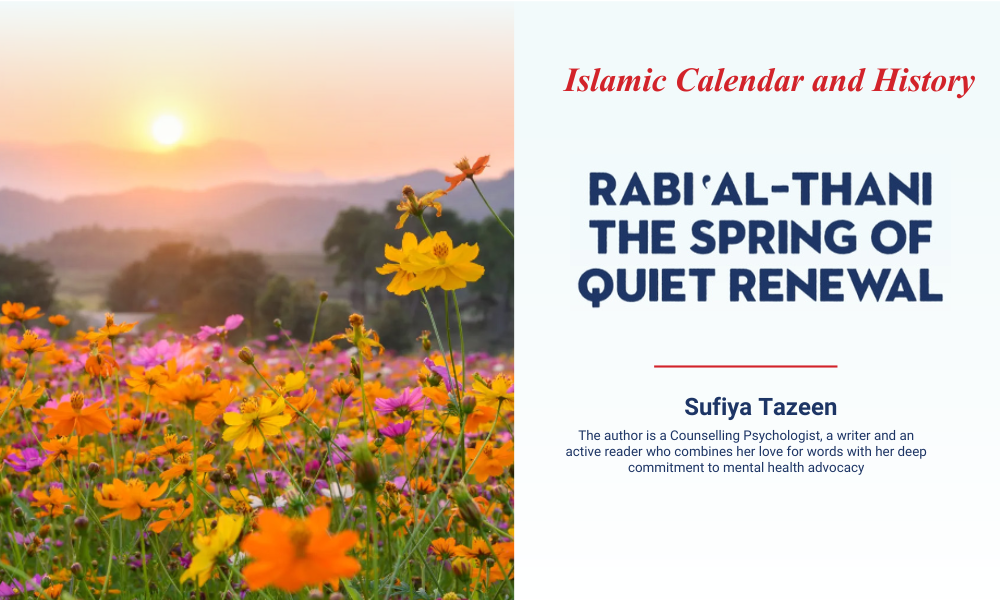
The author is a Counselling Psychologist, a writer and an active reader who combines her love for words with her deep commitment to mental health advocacy
In the Islamic lunar calendar, some months are widely awaited. Ramadan, with its forgiveness and fasting, Dhul Hijjah with its pilgrimage, and Rajab with its religious significance arrive with great expectations. The fourth month of the Islamic year, Rabiʽ al-Thani, is peaceful and frequently left unnoticed among the hustle bustle of daily living.
Rabiʽ al-Thani can seem humble at first. It does not fall under the four holy months. It is not associated with any particular fasts or acts of worship. But to those who stop and look more closely, it provides meaning, much like a silent instructor or a changing season.
The Spiritual Significance of Rabiʽ al-Thani
Rabiʽ al-Thani also known as Rabiʽ al-Akhir or Rabiʽ al-Akhar is the 4th month of the islamic lunar calendar. During the times of the Ottoman Caliphate, Rabi’Al Thani was referred to as Rèbi’ al-Aher, which likely contributed to the alternative name Rabi’ al Akhir, which refers to “the latter spring”.
Even though Rabiʽ al-Thani does not fall under the banner of the four sacred months—Dhul Qa’dah, Dhul Hijjah, Muharram, and Rajab that Prophet Muhammad ﷺ specifically mentioned, it still plays a pivotal role in our spiritual lives. This month offers a great opportunity for self-reflection and personal growth for believers. Islam encourages each one of us to not just be devoted in the holy months but throughout the year , and every moment of worship done with sincerity and honesty does not go in vain on the scales of Ar-Rahman.
While the Qur’an and Sunnah doesn’t highlight any specific events or practices for this month, it’s a chance for believers to pause, reflect, and prepare for the blessed months ahead. Since Rabiʽ al-Thani marks a quarter of the Islamic year, it’s the perfect time to rethink our personal, professional and spiritual choices and work tirelessly to renew our commitment to our faith.
Echoes of the Past: The Silent Majesty of Rabiʽ al-Thani
Rabiʽ al-Thani often passed over on the calendar without the glitter of grand festivities is a month that moves quietly, yet powerfully, through the corridors of history. It does not call attention to itself with the fanfare of Eid, nor does it demand ritual celebration. And yet, in its stillness, it echoes with greatness. This is the month where the silence is louder than the beats of grandeur and remembrance has an aroma of fresh breath. It’s a time which is soaked in the legacy of scholars who have left behind a generational wealth of spirituality. Among the most luminous souls remembered in Rabiʽ al-Thani is Sheikh Abdul Qadir al-Jilani (رحمه الله), who passed away on the 11th of this month in 561 AH (1166 CE). A name that does not just echo through Sufi gatherings but vibrates through the heart of Islamic spirituality like a quiet flame that never dies out. He got the title al-Ghawth al-Aʿzam the Greatest Helper. But his greatness didn’t lie in mere titles. It flowed from his humility, his clarity of purpose, and the incandescent light of a heart anchored with unwavering faith in Allah.
His life began in an era of conflict and constant change, Sheikh Abdul Qadir’s response was neither retreat nor rebellion, but inner mastery. He purified his heart until it reflected Divine presence. He taught that the path to Al Haqq, is walked with truthfulness, self-discipline, compassion, and relentless remembrance. His words weren’t just teachings; they were transformations. In many corners of the world, Rabiʽ al-Thani becomes a sacred invitation to reread his words, to sit with his sermons, to reflect on what it means to live inwardly sincere in an outwardly chaotic world.
But Sheikh Abdul Qadir was not alone in lighting the path of renewal of faith. This month also marks the passing of other towering figures such as Caliph Al-Mu’tasim Billah, son of the legendary Harun al-Rashid, whose reign was marked by military might and cultural renaissance.
And then there was Imam Ibn al-Jawzi, the polymath and a preacher of Baghdad, whose prolific writings still stir minds and awaken hearts. Through his sharp intellect and emotional depth, he reminded us that knowledge is not just gained to display through sermons, but imbibed to bring about lasting transformation.
The great personalities who departed this world should not be remembered as historical figures, but should be looked upon as living signs, signs of what it means to live a life of purpose. They sought not comfort but meaning. Not fame, but devoted service towards humanity. Their departure, remembered in this month, is not about holding gatherings of mourning but about mirroring their legacy left behind.
So let Rabiʽ al-Thani enter our lives with the glad tidings of renewal and growth. Let it be a personal season of remembrance and restructuring our personalities. A second spring — not just of the earth, but of our spirit.
Not every month needs celebration. Some months are for awakening.
Spirituality in the Everyday
While Rabiʽ al-Thani doesn’t prescribe specific acts of worship, the beauty of Islam lies in the consistent opportunity for closeness to Allah—no matter the month. Every day is a canvas. Every intention can carry weight.
Here are gentle reminders for how believers can bring light into their days during this time:
- Recite and ponder over the Qur’an: reciting theQur’an with understanding will help in fruitful transformation of the self.
- Pray extra nawafil—voluntary prayers that express love for the Almighty beyond mere obligations.
- Engage in Dhikr: conscious and mindful remembrance of Allah, by performing every act of daily living for the sole purpose to please the Almighty.
- Fast voluntarily: even one day done with sincerity is a treasure.
- Extend kindness: helping someone in need, caring for the sick, or simply offering a smile.
- Reflect: delve deeply in the depths of the self and evaluate where do you stand and where does your heart lean towards.
These acts don’t need grandeur. Their value lies in sincerity. And that’s perhaps the quiet message of Rabiʽ al-Thani: that the soul blossoms not only in the extraordinary, but also in the simple, sincere moments. This is a season to pause, reflect, and breathe. To ask: What am I holding onto that no longer serves me? What parts of me are ready to bloom?
Personal growth isn’t always loud. Like spring, it begins in silence — in mindful moments, in the stillness between thoughts, in the choice to show up better each day. A deeper breath. A clearer intention. A gentler way of being. Let Rabiʽ al-Thani be your second spring — not just in the calendar, but in your heart. Start again, with awareness. Grow slowly, with grace. Bloom inward, before outward.
These acts don’t need grandeur. Their value lies in sincerity. And that’s perhaps the quiet message of Rabiʽ al-Thani: that the soul blossoms not only in the extraordinary, but also in the simple, sincere moments. This is a season to pause, reflect, and breathe. To ask: What am I holding onto that no longer serves me? What parts of me are ready to bloom?

0 Comments